Emergencies | How-to
The Drain That Blocks Every Winter: Thames-Side Pressure, Roots or a Broken Joint?
Your drain behaves all summer then backs up every winter. Here is how to tell whether the Thames, tree roots or a broken joint is to blame.
Published 20 July 2026
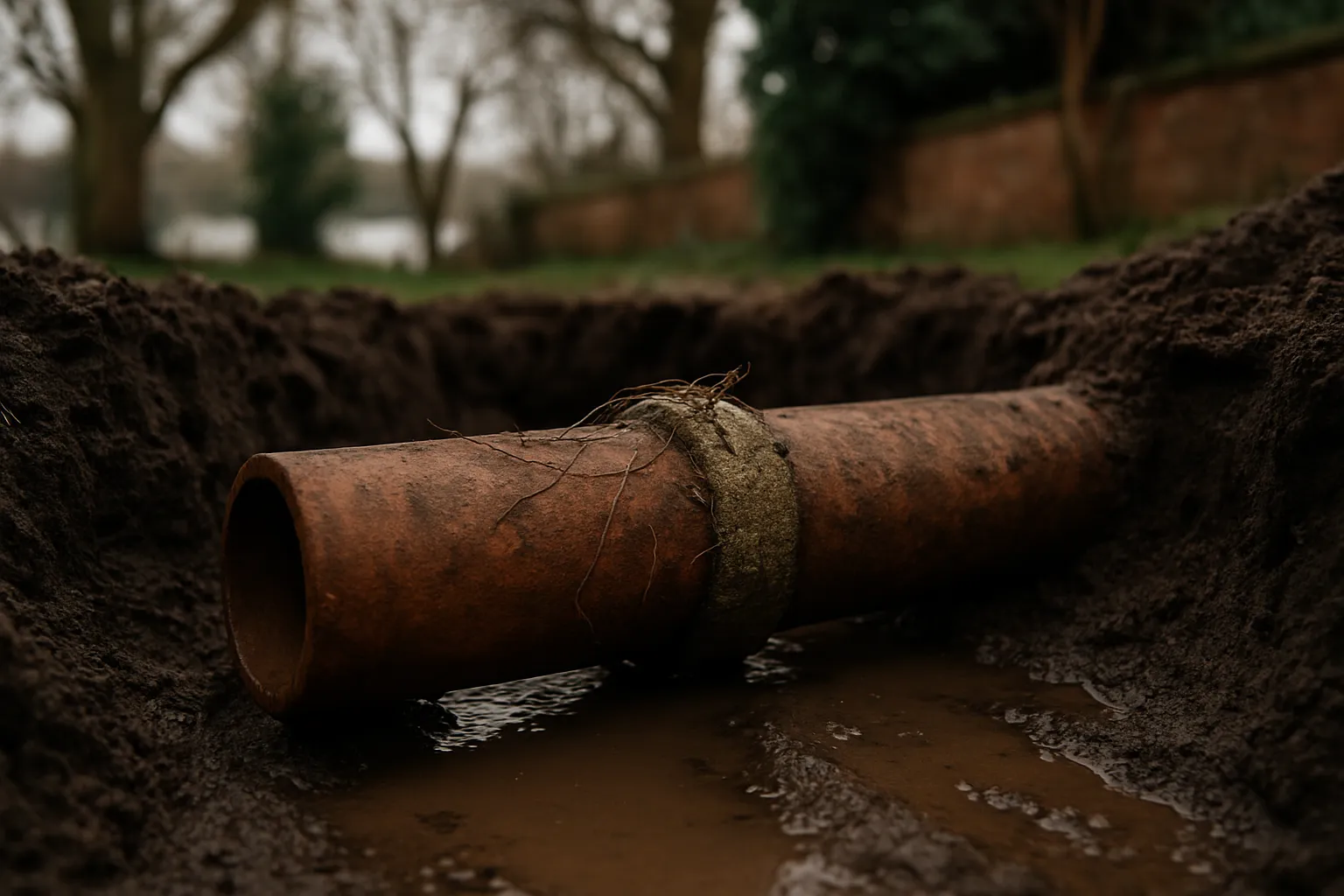
You Have a Very Punctual Drain
Every November, like clockwork, your drain backs up. Every April, it quietly forgives you and behaves itself again. You have called someone out twice, they have jetter-cleared it, charged a fair amount, and left. Then winter comes back. So does the blockage.
Here is the thing: that drain is trying to tell you something, and repeated clearance is not listening to it. It is just turning the volume down until next year.
If you are in Richmond, Twickenham, Teddington, Hampton or anywhere else along the Thames corridor, there are three distinct reasons a drain can behave seasonally. They look similar on the surface. They need completely different fixes. This guide is about telling them apart.
Suspect One: Downstream Surcharge (The Thames is Pushing Back)
Surcharge means the sewer downstream of your property is already full, so your wastewater has nowhere to go and backs up into your pipe instead. Think of it as a motorway that is gridlocked at the junction, so traffic stacks up on the slip road.
In a riverside postcode, the culprit is often a combination of high groundwater, a swollen Thames and a Victorian combined sewer that was never designed for 2026 levels of rainfall. When river levels rise, water can infiltrate the public sewer network at low points, reducing its capacity. Your drain is not blocked at all. It is just queuing.
How to spot it: The problem affects multiple fixtures at once (bath, basin and toilet all sluggish together). It tends to ease within a day or two as water levels drop. There is no persistent smell between episodes. Clearing the drain with a jetter makes no lasting difference because there was never anything to clear.
What to do: A CCTV survey (a small camera sent along the inside of the pipe, giving a live video picture of the pipe wall and any contents) during a high-water period can confirm whether your pipe is structurally sound and simply being overwhelmed. If surcharge is the diagnosis, Thames Water may have a responsibility for the public sewer. Your drainage engineer can give you the evidence you need to make that conversation with them.
Suspect Two: Root Ingress
Tree roots are, professionally speaking, extraordinary. A fine root tip can find a hairline crack in a clay drain, follow the moisture gradient inward, and then spend the next five years quietly filling your pipe like very determined spaghetti. Come winter, when the ground is saturated and the pipe is working harder, that partial obstruction becomes a total one.
Riverside gardens in Richmond and Twickenham are well planted. Mature willows, oaks and plane trees are everywhere, and their root systems are proportionally ambitious.
How to spot it: The blockage tends to be in the same section of run every time. A jetter clears it but the problem returns within one to two seasons. You may notice the drain is slower than usual even in summer if you pay attention.
What a CCTV survey shows: Root ingress is unmistakable on camera. The roots look exactly like the inside of a very small, very inconvenient cave. Once we know where they are entering and why (a cracked joint, a displaced pipe section), we can give you a proper repair option rather than another temporary clear.
Suspect Three: A Displaced Joint or Structural Damage
Clay drain pipes laid in Victorian and Edwardian Richmond were jointed with cement mortar. That mortar has had a century to dry out, shrink and crack. Ground movement, nearby construction and the seasonal heave of waterlogged riverside soil all put stress on those joints. When a joint opens up, you get three problems at once: groundwater infiltrating the pipe (reducing capacity), soil gradually migrating in (building a partial blockage), and roots finding an easy entry point.
A broken or displaced joint is not a blockage. It is a structural fault. Jetting it clears the accumulated debris but does nothing about the gap in the pipe wall.
Repair options: Depending on the location and severity, the options typically range from patch lining (a resin sleeve inserted and cured inside the pipe at the fault point, sealing the gap without excavation) to full pipe relining (the same principle applied to a longer run) to excavation and replacement where the damage is too severe for a no-dig approach. Indicative costs for patch lining in a domestic run start in the low hundreds; full relining of a longer run can reach into the thousands. A survey gives you the specific picture before any work is quoted.
Why a Winter CCTV Survey Is Worth Doing
A survey in August tells you what the pipe looks like when conditions are easy. A survey in January, when groundwater is high and the pipe is under real pressure, tells you what is actually causing the problem. If surcharge is a factor, the camera may show water already standing in the lower sections of the run. If a joint has opened, you may see active infiltration. The timing matters.
Repeated Clearance Is Not a Repair
This is the honest part. Jetting a drain that has a structural fault is like bailing a boat with a hole in it. It is not wrong to do it in an emergency, and sometimes it is the only option available at midnight in November. But it does not fix the underlying problem, and every winter that passes without a proper diagnosis is another winter of the same outcome.
If your drain has backed up two or more winters in a row, the most useful thing you can do is get a CCTV survey done in the colder months, when the real conditions are present, and get a written report that tells you exactly what you are dealing with.
If you are in the Thames corridor and your drain is backing up right now, call Drainiacs on 07700 137648. We cover Richmond, Twickenham, Teddington, Hampton and the surrounding TW postcodes, twenty-four hours a day. We will tell you honestly what we find and what it will actually take to fix it.
The same cold snap freezes supply pipes. Our sister plumbing firm Emergency Plumbers TW keep a local frozen pipe checklist.