Emergencies | How-to
Hounslow's Clay Soil and Your Drains: Why the Ground Itself Fights Your Pipes
London clay shrinks, swells and cracks pipe joints. Here's why Hounslow drains fail more than most, and your repair options ranked by cost and disruption.
Published 5 July 2026
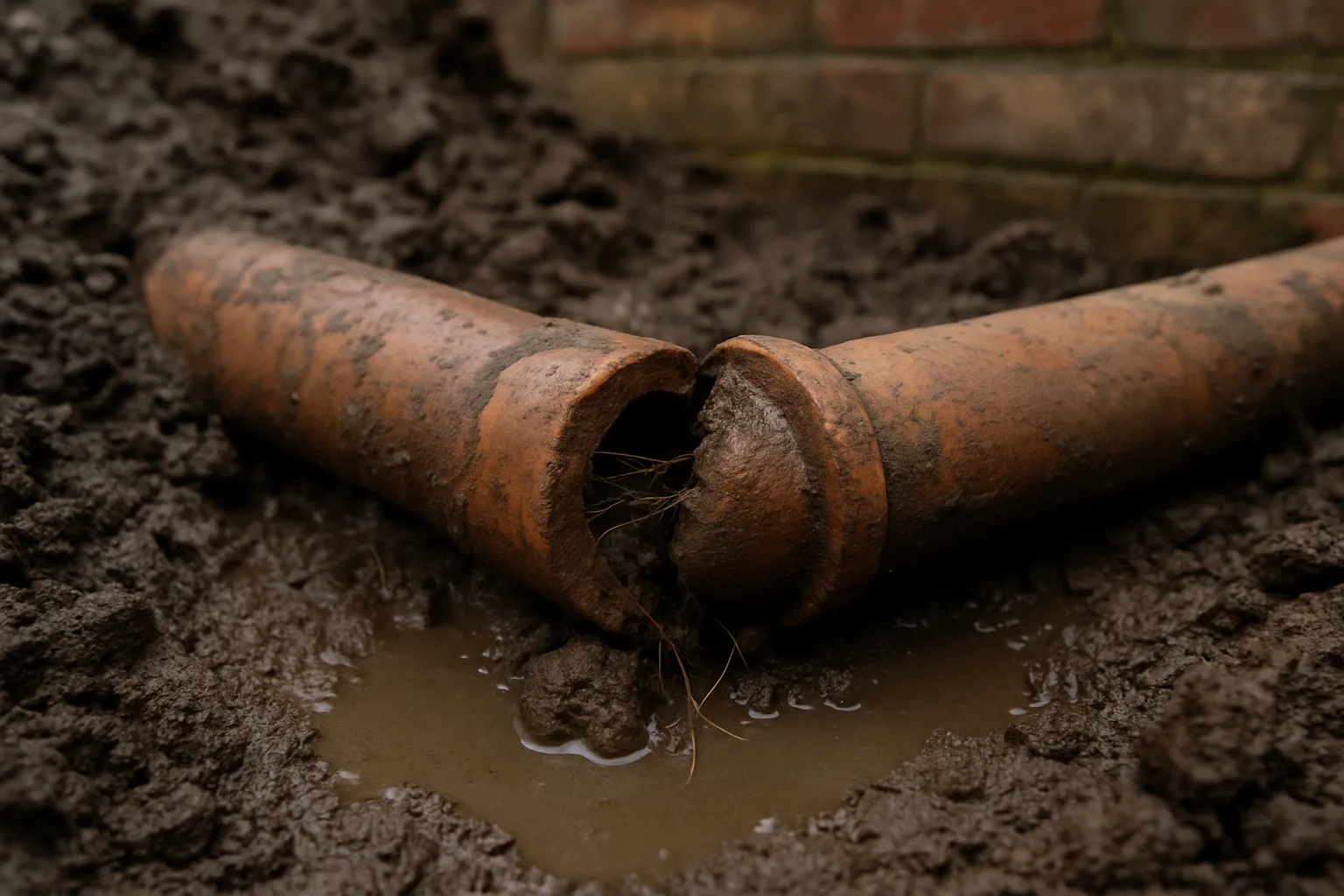
The Ground Under Hounslow Has a Grudge Against Your Drains
Most people blame the pipes when a drain fails. In Hounslow, the pipes are often perfectly innocent. The real culprit is sitting about 30 centimetres below your garden, minding its own business while quietly dismantling everything you own underground. It is London clay, and it is magnificent in the worst possible way.
London clay covers a huge swathe of west London, and Hounslow sits right in the thick of it. The clay is ancient, dense, and deeply unreasonable. In summer it dries out and shrinks. In winter it absorbs water and expands. Year after year, season after season, this movement works on every pipe joint in the ground like a slow-motion vice. Eventually, something gives.
That something is usually your drains.
What Clay Soil Actually Does to a Drain
Older drainage systems in Hounslow, particularly those laid before the 1980s, were built with short sections of pipe joined together rather than continuous runs. Each joint is a potential weak point. When the clay shifts, it pushes and pulls those joints out of alignment. The technical term is “root ingress” when tree roots find the gap, and “joint displacement” or “pipe settlement” when the pipe simply moves out of true.
Root ingress means tree roots have found a crack or gap in a pipe and grown into it. Joint displacement means the pipe sections have physically shifted apart or dropped. Both let groundwater into the drain, and both let sewage leak out into the surrounding soil.
Once a joint is open even slightly, tree roots from nearby gardens find it within months. Hounslow has generous street tree planting and mature garden trees, which is lovely for the neighbourhood and catastrophic for aging clay-jointed pipework underneath it.
How to Tell If Clay Movement Is Your Problem
You will not see the clay moving. What you will see is:
- Drains that block repeatedly in the same place despite being cleared
- Slow drainage that gets worse after a dry summer or a wet winter
- Damp patches or sinkholes appearing in the garden with no obvious cause
- A smell of sewage outside, particularly near the boundary of your property
- Cracks appearing in external brickwork or paths near inspection covers
None of these symptoms are definitive on their own. The only way to know for certain what is happening underground is a CCTV drain survey. That means sending a small camera through the pipe on a flexible cable to record exactly what is there. It takes about an hour for a standard residential run, typically costs between £90 and £180, and produces footage showing every crack, root, joint gap and collapsed section. Think of it as a nature documentary about your drains. The camera finds things that have been quietly happening for years, and they are, professionally speaking, fascinating.
Your Repair Options, Ranked by Disruption and Cost
1. Drain jetting with root cutting (lowest disruption, lowest cost)
If roots are the main problem and the pipe is otherwise sound, a high-pressure jet with a root-cutting head can clear the blockage and buy you time. Typical cost: £100 to £250. This is not a permanent fix if the joint is already open, because the roots will return, but it restores flow immediately and confirms whether a more permanent repair is needed.
2. Patch lining (low disruption, moderate cost)
If the CCTV survey shows a specific cracked section or displaced joint, a short patch liner can be installed without digging. A resin-impregnated sleeve is pushed to the damaged section and inflated against the pipe wall, then left to cure. Relining means creating a new pipe surface inside the old one, sealing cracks and gaps from the inside without excavation. Cost for a patch repair: roughly £300 to £600 depending on depth and access.
3. Full drain relining (moderate disruption, moderate to higher cost)
Where a longer run is damaged or multiple joints are compromised, a full lining is more economical than patching section by section. The whole pipe gets a continuous resin sleeve. No digging, no reinstatement of your garden or driveway. Typical residential cost: £500 to £1,500 depending on pipe diameter and length.
4. Excavation and pipe replacement (highest disruption, highest cost)
Sometimes the pipe has collapsed entirely or dropped so far out of alignment that lining is not possible. In that case, the ground has to be opened and the pipe replaced. This is disruptive and more expensive, ranging from £800 to several thousand pounds depending on depth, length and what is in the way. It is the right answer when it is the only answer, and a proper CCTV survey will tell you before any work begins whether you are in this category.
A Word on Timing
Clay movement is worst at the extremes of the seasonal cycle: late summer after a prolonged dry spell, and midwinter after heavy rain. If your drains are already showing symptoms, those are the moments when a borderline situation becomes a failure. A cracked pipe that was coping in spring may not cope in August.
The Structural and Health Risks of Ignoring This
This section is written straight, because it matters.
A leaking drain that is discharging sewage into surrounding soil is a public health risk. Untreated sewage contains bacteria, viruses and parasites. If it reaches a soakaway, a garden, or (in worst cases) a water table, the consequences are serious. Structurally, a drain that has been leaking for years can erode the soil beneath foundations, which is a building stability issue, not just a drainage issue. If you have any suspicion that a drain is leaking near your house foundations, do not delay getting a survey. This is not a situation where watching and waiting is a sensible strategy.
If you are in Hounslow or the surrounding TW postcodes and your drains are giving you trouble, call Drainiacs on 07700 137648. We are available around the clock, we carry CCTV survey equipment on every van, and we will tell you exactly what is happening underground before recommending any repair.