How-to
Autumn Leaves and the Gully Chain: How TW Gardens Silt Up Their Own Drains
Leaves plus silt plus a dodgy fall equals a blocked gully. Here's the chain that actually clogs TW drains every autumn, and how to fix it yourself first.
Published 17 July 2026
Autumn Leaves and the Gully Chain: How TW Gardens Silt Up Their Own Drains
Every October, the plane trees along Broad Lane and the limes lining the streets off Bushy Park do something magnificent. They turn gold, they turn amber, they turn a spectacular russet brown, and then they fall directly into your gutters and quietly destroy your drainage.
This is not a gutter blog. This is about what happens after the gutter, because that is where window-cleaner advice runs out and real drainage problems begin.
The Chain Nobody Talks About
A blocked drain rarely happens in one place at once. It happens in a sequence. Understanding the sequence is the difference between a five-minute job with a pair of gloves and a £300 call-out you could have avoided.
Here is the chain:
1. The gutter fills with leaves. Plane and lime trees are the worst offenders in TW: large leaves, late drop, and they mat together like felt when wet.
2. The downpipe carries a slurry, not water. Once the gutter is overwhelmed, water carries leaf fragments and grit down the pipe in a thick, tannin-dark soup.
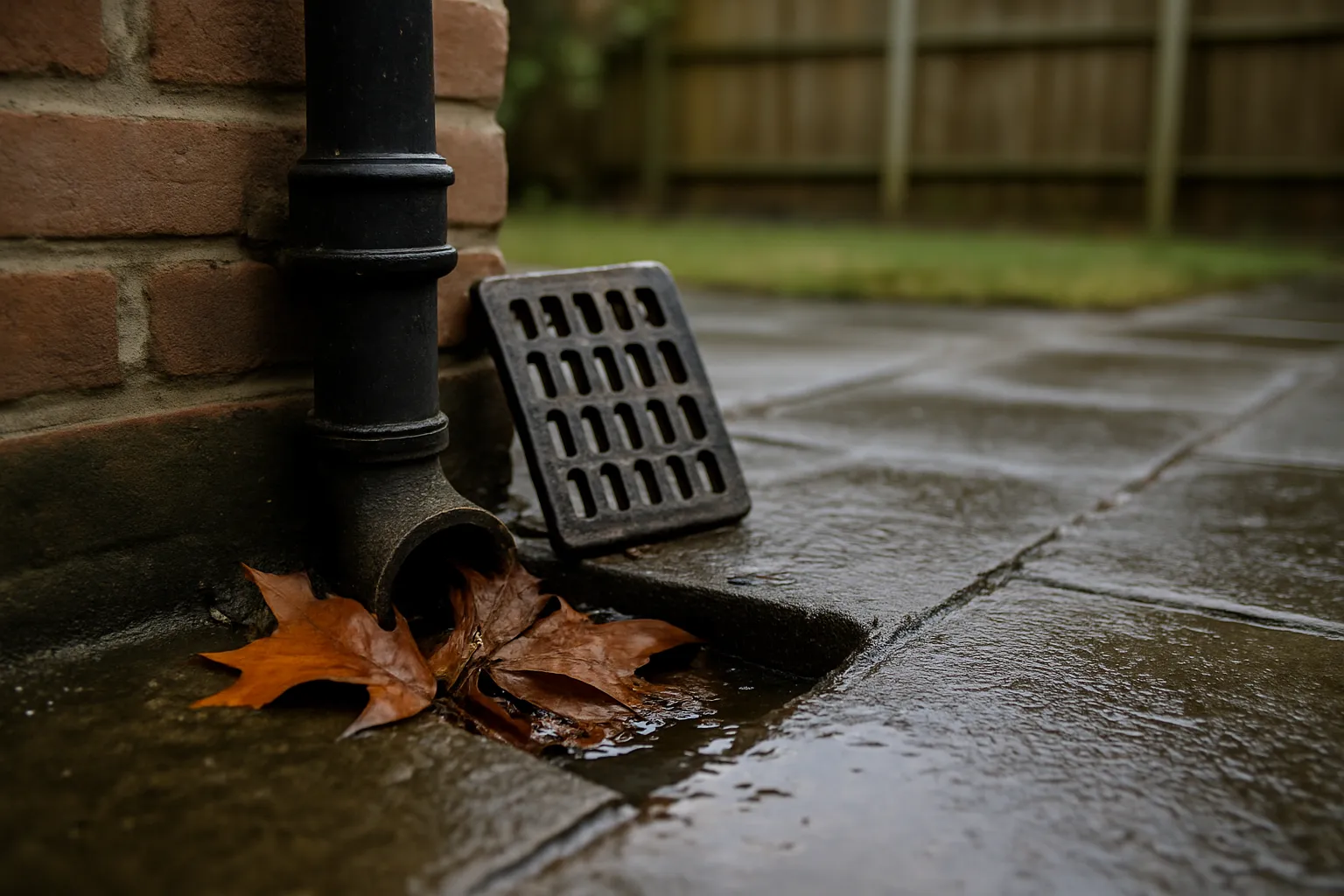
3. The back-inlet gully receives it. A back-inlet gully (the small square or round pot at the base of your downpipe, sitting at ground level) is designed to accept surface water and pass it underground. It has a water-filled trap at the bottom, which acts like a U-bend, blocking sewer gases from rising back up. That trap is also a perfect leaf-and-silt collector.
4. The underground run silts up. Leaves alone rarely block a pipe. A healthy pipe with a good fall (the slope that keeps water moving) will flush most debris through. But leaves plus silt plus a pipe that has lost even a degree or two of its original fall? That is a plug in the making.
The gully is where leaves and silt get married, settle down, and cause serious trouble.
Why Teddington and Hampton Are Particularly Interesting (to Me, Anyway)
The streets immediately around Bushy Park, and the older residential roads of Hampton Hill and Teddington, were planted with large ornamental trees decades ago. Magnificent. Genuinely magnificent. They also shed an extraordinary volume of material into gutters that were designed for a different era’s rainfall patterns.
A wet October, which the TW area gets reliably, accelerates everything. A gully that was managing fine in September becomes a plug by the end of the first heavy rain. The water backs up, finds the path of least resistance, and that path is usually your patio, your side return, or, in the worst cases, back through the downpipe itself.
What to Do Yourself First
Before you call anyone, try this. It takes ten minutes.
- Lift the gully grate. Most are loose or held by a single bolt. You may need a flat-head screwdriver.
- Remove the visible debris. Leaves, silt, and whatever else has collected. A trowel or a gloved hand works. Bag it up; do not push it further into the pipe.
- Check the trap. Reach down into the gully pot. If it is packed solid with compacted silt, that is your blockage. Clear it out until you can feel standing water in the bottom of the trap.
- Run a hose into the gully. Watch whether the water drains freely or backs up around your feet.
If the water clears, you are done. Put the grate back, make a note to do this again in November, and carry on with your autumn.
If the water backs up after clearing the trap, the blockage is further along, underground. That is when you call.
When It Is Not a DIY Job
A backed-up underground run needs jetting. Drain jetting (a high-pressure water hose fed into the pipe) blasts silt and compacted debris out and flushes it to the sewer. A typical jetting visit for a blocked gully run costs in the region of £80 to £180, depending on the length of run and how compacted the blockage is. Most jobs are done within an hour.
If jetting does not fully resolve it, a CCTV survey (a small camera fed through the pipe to show exactly what is happening inside) will find out whether the fall has changed, whether roots have entered the pipe, or whether the pipe itself has cracked or displaced. Root ingress, by the way, means tree roots have grown into a joint or crack and are now acting as a very effective net for catching everything else that passes through. The lime and plane trees that cause the leaf problem above ground are equally enthusiastic below it.
A CCTV survey typically costs £100 to £250 for a residential drain.
A Word on Timing
The best time to clear your gully is before the leaves fall. The second best time is immediately after the first heavy October rain. The worst time is when your patio is underwater and you are standing in it in your socks.
Kev, our lead jetter, has a theory that the universe specifically waits until a Friday evening in late October before sending the rain that turns a manageable gully into a genuine emergency. Kev has been jetting drains in TW for eleven years. He may be right.
If You Are Already Past the DIY Stage
If your gully is backing up, your patio is flooding, or water is appearing somewhere it should not be, call Drainiacs on 07700 137648. We cover Teddington, Hampton, and the surrounding TW postcodes around the clock. We will tell you honestly whether it is a quick jet or something more involved, and we will give you a price before we start.
Clear the gully now, while the trees are still green. Future you, standing dry on a dry patio in October, will be grateful.