How-to
Drain Jetting vs Rodding in TW: Which Fix Does Your Blockage Need?
Rodding or jetting? A straight local guide for TW homeowners: what each method does, what it costs, and how to choose the right one first time.
Published 20 July 2026
The Short Answer
Rodding punches a hole through a blockage. Jetting scours the pipe wall clean. One makes a passage; the other removes the problem. Get that distinction right and you pick the correct fix first time, which saves you money and a repeat call-out.
Here is the longer version, grounded in what we actually find under TW postcodes every week.
What Rodding Actually Does
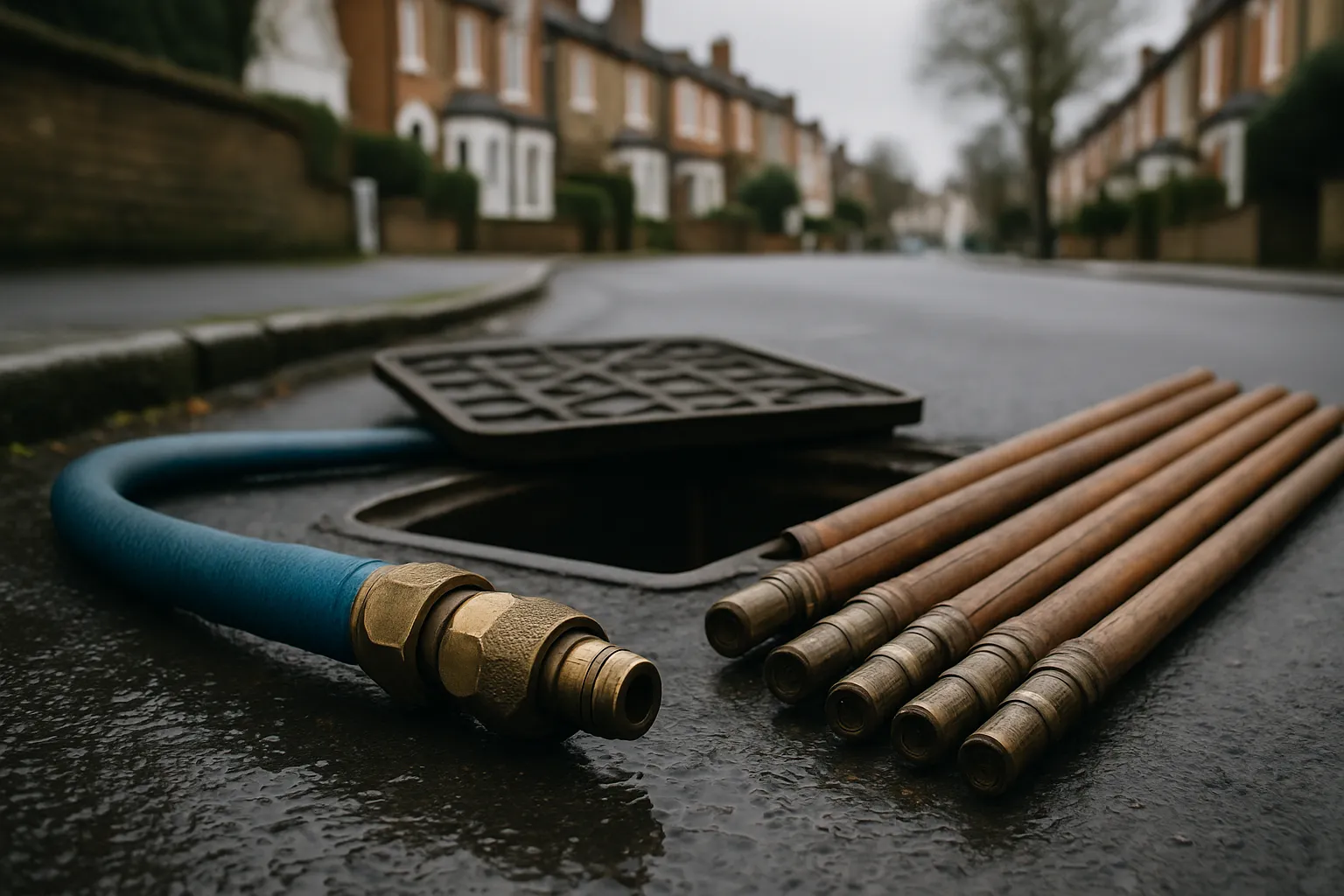
Drain rods are interlocking fibreglass poles that a technician feeds into the pipe and rotates by hand. A plunger or corkscrew head on the front breaks up or dislodges a soft blockage, and the flow restores.
It is a perfectly honourable method. The rods have been doing this job since the Victorians were busy laying the clay pipes that still run under large parts of Twickenham, Richmond and Isleworth. There is something almost poetic about using Victorian-era technology to clear Victorian-era pipes. We find this delightful. You probably just want your sink to drain.
Rodding works well when:
- The blockage is a first-time event, not a recurring one
- The cause is a soft, recent accumulation (a clump of wipes, a build-up of food waste near the trap)
- The pipe run is reasonably straight and accessible
- There is no history of root ingress or scale build-up (more on those below)
Indicative cost for a straightforward rod-out: roughly £60 to £120 depending on access and time of day.
What Drain Jetting Actually Does
High-pressure water jetting sends water through the pipe at up to 4,000 psi via a flexible hose with a specialist nozzle. The forward-facing jets cut through the blockage; the rear-facing jets propel the hose forward and simultaneously blast the pipe wall clean.
That last part is the key difference. Jetting does not just restore flow, it removes the layer of grease, scale and sediment that was narrowing the pipe in the first place. Think of rodding as reopening a door and jetting as taking the door off its hinges, sanding the frame and rehinging it properly. We find this analogy extremely satisfying. The drains find it thorough.
Jetting is the right call when:
- Grease or cooking fat has built up along the pipe wall (common in older TW terraces with cast-iron or clay kitchen runs)
- The blockage keeps coming back within weeks or months
- A CCTV survey (a camera inspection, where we send a live-feed camera through the pipe to see exactly what is happening) has revealed scale, root ingress or a partial collapse
- You are dealing with a main sewer line or a longer run where rods cannot reach effectively
- The drain serves a commercial kitchen or a property with multiple occupants
Indicative cost for high-pressure jetting: roughly £100 to £250 for a standard residential run. Longer or more complex jobs cost more, and we will tell you the likely range before we start.
The TW Factor: Victorian Clay and What Lives Inside It
A significant proportion of the drainage network across Twickenham, Richmond, Whitton, Isleworth and Brentford is original Victorian clay pipe. Clay is durable but it has open joints, and over 120-odd years those joints become entry points for tree roots. The large plane trees and mature garden growth across much of TW are genuinely beautiful. They are also professionally fascinating from a drainage perspective, because their roots will find every joint in a clay run and explore it with great enthusiasm.
Root ingress (tree roots that have grown into the pipe, partially or fully blocking it) cannot be cleared by rodding alone. Jetting with a root-cutting nozzle cuts the roots back. A follow-up CCTV survey then confirms whether the pipe structure is still sound or whether relining (inserting a new pipe lining inside the old one, without digging) is needed.
If you are in a Victorian or Edwardian property anywhere in the TW postcode and your drain blocks more than once a year, roots or joint displacement are the most likely cause. Jetting plus a camera look is the sensible next step.
Decision Tree: Rods or Jetting?
Work through this in order.
- Is this the first time this drain has blocked? Yes: rodding is a reasonable starting point. No: go to step 2.
- Did the last rod-out last less than three months? Yes: the underlying cause was not cleared, so jetting is needed. No: rodding may still be appropriate.
- Is there grease, cooking fat or a known build-up involved? Yes: jetting only. Rods will punch through but leave the grease layer, and it will close again.
- Is the property Victorian or Edwardian with mature trees nearby? Yes: consider booking a CCTV survey alongside whichever method you choose, so you know the pipe condition.
- Is this a commercial property or a drain serving a kitchen? Yes: jetting is the standard approach. Rodding is rarely sufficient.
Honest Guidance on Costs
We do not publish fixed prices because pipe length, access difficulty, time of call-out and what we actually find all affect the final figure. What we will always do is give you a clear quote before work begins. No surprises on the invoice.
Ballpark ranges for TW residential jobs:
- Rodding a standard blockage: £60 to £120
- High-pressure jetting: £100 to £250
- CCTV drain survey: £150 to £300
- Jetting plus CCTV combined: often more cost-effective than booking separately
When to Call Right Now
If you have raw sewage backing up into the property, water pooling at ground level, or a smell suggesting a collapsed pipe, stop reading and call. These are not situations to monitor overnight.
Drainiacs cover the full TW postcode area, 24 hours a day, seven days a week. If you are in Twickenham, Richmond, Hounslow, Feltham, Staines, Shepperton, Hampton, Teddington, Brentford or anywhere else in the TW area and you need a drain looked at today, call us on 07700 137648.