How-to
Fatberg Autopsy: What's Actually Inside the Lumps We Jet Out of Local Sewers
A layer-by-layer dissection of what fatbergs are made of, why they grow in TW-area drains, and how to stop the next one forming under your street.
Published 6 July 2026
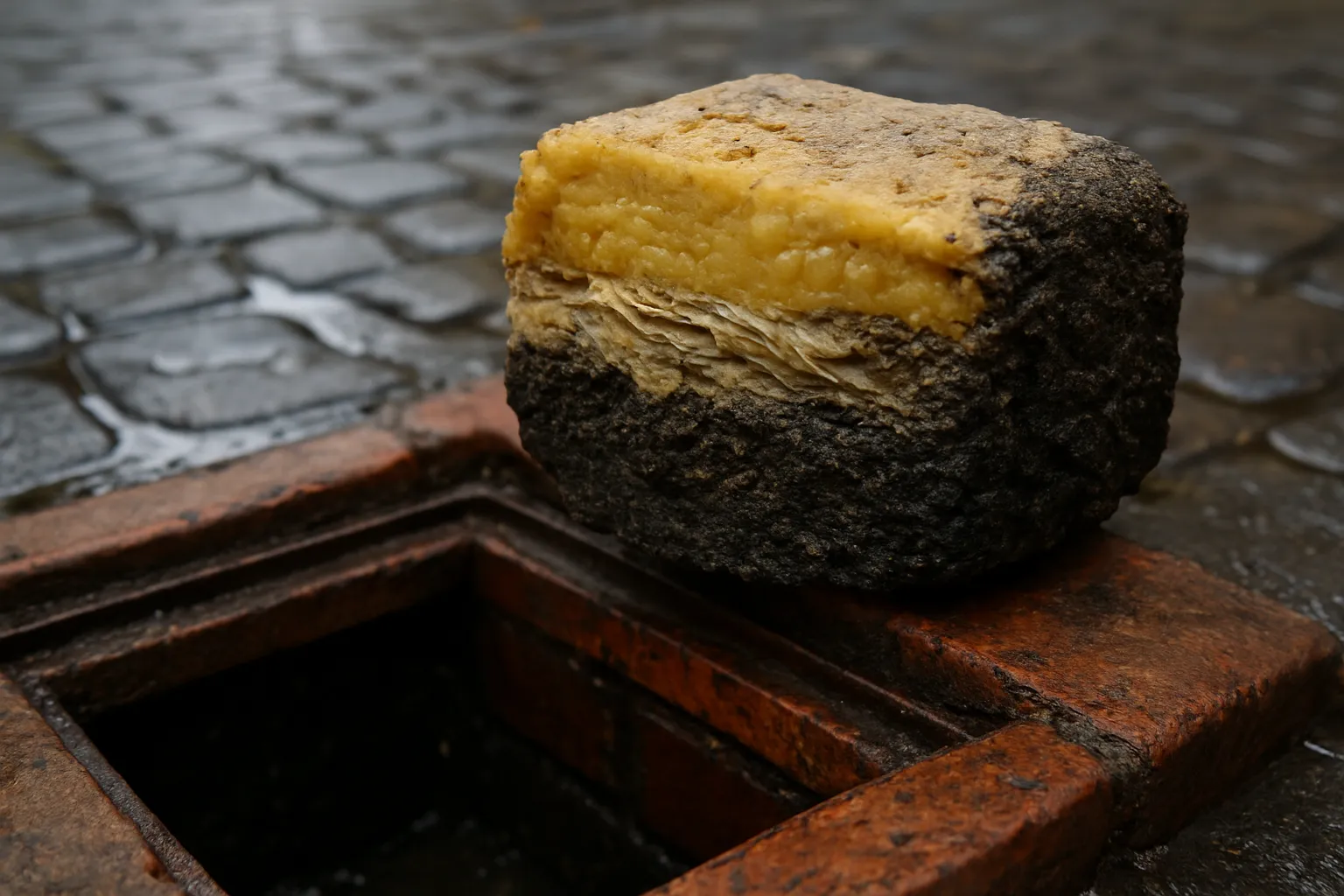
Fatberg Autopsy: What’s Actually Inside the Lumps We Jet Out of Local Sewers
I have looked into a lot of drains. I have peered down inspection chambers at three in the morning while a fox watched me from a garden wall. I have seen things that would make a marine biologist weep with envy. And nothing, absolutely nothing, holds a candle to the fatberg: that glistening, semi-solid monument to everything the modern household puts down its sink and toilet without a second thought.
This is a professional appreciation. A love letter, if you will. A geological survey of one of the most underrated formations in the TW postcode area.
Let us begin the autopsy.
Layer One: The Foundation (Cooking Fat and Grease)
Every fatberg starts as a liquid. Hot fat from a roasting tin, cooking oil poured down the kitchen sink, the greasy rinse water from a pan. It goes down warm and runny, and you think: job done.
Then it hits the cooler pipe walls. Fat solidifies at around 40 degrees Celsius. Your drain is not 40 degrees. Your drain is closer to 12. The fat coats the inside of the pipe in a thin, waxy film, the way candle wax coats the side of a glass. Each pour adds another coat. Over weeks and months, the bore of the pipe narrows.
Prevention at this layer: Let fat cool, scrape it into a sealed container, and put it in the bin. Even a small roasting tin worth of fat, done properly every time, makes a measurable difference to what we find downstream. No products required. No special equipment. Just a tin and a bin.
Layer Two: The Scaffold (Wet Wipes and Non-Flushables)
Here is where the fatberg stops being a film and starts being a structure. Wet wipes, cotton pads, cotton buds, dental floss, sanitary products: these are the steel rods in the concrete. They do not dissolve. They do not break down in water. They travel along the sewer until they hit a grease-coated surface, and then they stick.
“Flushable” wipes are, to put it gently, optimistically labelled. Water companies and drainage engineers across the country have been saying this for years. A standard wet wipe will survive a drain journey largely intact. It will then bond to fat, catch the next wipe, and begin to form a mat.
That mat is the skeleton of everything that follows.
Prevention at this layer: Bin every wipe, every cotton pad, every cotton bud. The toilet is for the three Ps: pee, poo and paper. Everything else belongs in the bin. If the packaging says flushable, treat that as a suggestion you are politely declining.
Layer Three: The Filler (Food Waste and Soap Scum)
Once the scaffold is in place, the fatberg becomes a collector. Food particles, soap scum (which is itself partly fat, reacted with the minerals in hard water), coffee grounds, rice grains, pasta: all of it gets trapped. The structure grows denser and harder. Older fatbergs can calcify until the blockage behaves less like cooking waste and more like wet concrete starting to set.
Hard water areas, which includes most of the TW postcode, accelerate this process. The calcium in the water reacts with the fatty acids and produces a soap-like compound that sets hard. Brentford, Isleworth, Hounslow: your water is doing the fatberg a favour.
Prevention at this layer: Fit a sink strainer to catch food waste. Avoid pouring pasta water, rice water or starchy cooking water down the drain in large quantities. Run hot (not boiling) water down the sink after washing up, rather than cold.
Layer Four: The Ecosystem (Yes, Really)
A mature fatberg is not inert. It is a habitat. Bacteria colonise it. Hydrogen sulphide gas builds up inside it, which is both flammable and toxic at high concentrations. In very large formations, the gas pressure can contribute to drain surcharging, where the sewer backs up and sewage finds the nearest available exit, which is sometimes a toilet or a ground-floor drain.
This is the point at which the autopsy stops being interesting and starts being a public health matter. Raw sewage exposure carries genuine risks: E. coli, hepatitis A, leptospirosis (Weil’s disease). If sewage is backing up into your property, keep people and pets away from the affected area, do not use the drainage system, and call immediately.
What Happens When We Find One
Our CCTV survey (a small camera on a cable that travels through the pipe and sends back live footage, essentially a nature documentary you never asked for) shows the size and location of the blockage. From that we plan the jetting: controlled high-pressure water through a specialist nozzle that breaks up the deposit and flushes loose material out of the private run.
Typical domestic drain jetting in the TW area costs £150 to £300 depending on the length, access and condition of the run. A separate standard residential CCTV survey costs £150 to £350 when needed. We agree the scope and price before work starts.
The Honest Prevention Summary
| What goes down | What it becomes | What to do instead |
|---|---|---|
| Cooking fat | The foundation layer | Cool, jar, bin |
| Wet wipes | The structural scaffold | Always bin |
| Food waste | Filler and density | Strainer, then compost or bin |
| Soap and hard water | Calcified binding agent | Unavoidable, but reduced by hot-water rinse |
The fatberg is, genuinely, a remarkable object. A community art project nobody commissioned, made from the collective small decisions of thousands of households. I find them fascinating every single time.
But if one of them is currently making itself known in your drains, the fascination can wait. Call us on 07700 137648, any hour, any day. We cover the full TW postcode area and we will be with you fast.