How-to
Ashford's Long Gardens and Hidden Gullies: A Local Blockage Map
Where Ashford's hidden gullies lurk, why long private drain runs block unseen, and the two-minute autumn check that saves a callout.
Published 14 July 2026
Ashford’s Long Gardens and Hidden Gullies: A Local Blockage Map
Ashford is one of those quietly lovely corners of the TW postcode where the plots run deep, the hedgerows are mature, and the drains have been quietly doing their own thing since before anyone alive can remember. That last part is where it gets interesting. For a drain enthusiast (yes, that is what I am, no I am not sorry), Ashford is a genuinely compelling case study. For a homeowner, it can mean a blockage that has been building for six months before a single drop appears indoors.
Here is why, and what you can actually do about it.
Why Long Private Runs Are a Different Problem
In a terrace or a flat, the drain run from your kitchen or bathroom to the public sewer is short. A blockage builds, backs up quickly, and you notice within days. In Ashford’s longer semi-detached and detached plots, particularly around the streets feeding off Clarendon Road, Fordbridge Road and the quieter residential spurs near the Staines Road corridor, that private run can stretch eight, ten, even fifteen metres before it reaches the public sewer. That is a lot of pipe with no witnesses.
Grease, silt, leaf debris and root intrusion (tree roots finding their way into a pipe joint, which is more common than anyone wants to admit) have room to accumulate gradually. The system slows. Flow reduces. But because the blockage is far from the house, you see no obvious sign until it is severe. By then you are looking at a full clearance job rather than a quick flush, and potentially a CCTV survey to check whether the pipe itself has been compromised. A CCTV survey means we send a small camera down the drain on a cable and watch what it finds on a screen. Think wildlife documentary, but underground and with more grease.
Indicative cost for a standard drain clearance in Ashford: roughly £80 to £180 depending on severity and access. A CCTV survey on top: typically £150 to £250. Catching things early keeps you firmly in the first bracket.
Where the Forgotten Gullies Hide
A gully is the small grid-covered pot at ground level that collects water from downpipes, paths and patios before it enters the underground drain. In Ashford’s older properties, there are often more of them than the current owner knows about. Common hiding spots:
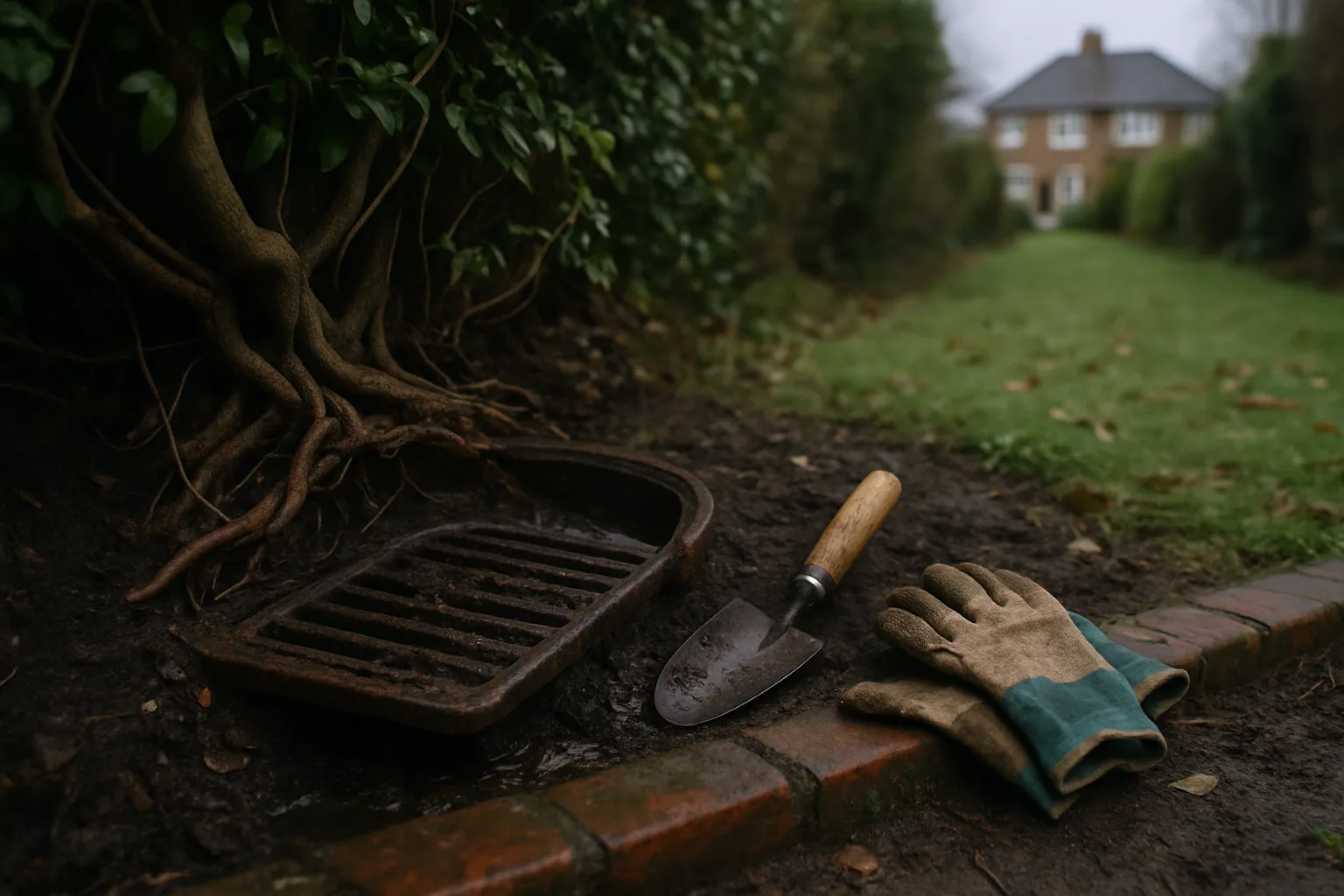
- Behind mature hedgerows. A gully installed in 1965 and then slowly engulfed by privet is a gully nobody clears. It is also a gully that fills with leaf mulch and backs up silently.
- Under decking. Decking installed over an existing gully is a situation we see regularly. The gully is still there, still connected, still collecting water from somewhere, and now completely inaccessible without lifting boards.
- At the foot of a side return or side passage. These narrow runs between house and boundary wall collect debris from both sides and are rarely swept. The gully at the end is often the last thing anyone checks.
- Alongside outbuildings and garages. Older garages in Ashford frequently have their own drainage connected into the household system. Easy to forget, easy to block.
Walk your boundary on a dry day. If you find a drain cover you did not know was there, congratulations: you have just found the most likely source of your next emergency callout.
The Two-Minute Autumn Check
Autumn is the critical window in Ashford. The mature street trees (and there are plenty of them, which is one of the reasons the area is so pleasant to live in) drop leaves directly into gullies and drain covers. Two minutes in October or November can genuinely prevent a January emergency.
- Lift each gully cover you can find. A flat-head screwdriver does it.
- Clear any leaf accumulation from the pot by hand or with a small trowel.
- Pour a bucket of water in. Watch it drain. If it sits there for more than five seconds, there is partial blockage below.
- Replace the cover. Done.
If the water sits, do not ignore it. A partial blockage in November is a full blockage by Christmas, often at the worst possible moment.
Root Ingress: Ashford’s Slow-Burn Problem
The mature trees that make Ashford’s streets attractive are also the ones whose roots seek out the small moisture leaks that occur at every pipe joint. Root ingress means tree roots have grown into the pipe, typically at a joint or a crack. Left alone, they eventually cause a collapse. Caught early, they can be cleared with a high-pressure water jet (a jetter, which is exactly what it sounds like) and the pipe can be relined without excavation. Relining means inserting a new structural sleeve inside the existing pipe, so you avoid digging up the garden.
If your drain is slow and your garden has mature trees within three or four metres of the drain run, mention it when you call. It changes what we bring.
When to Call Rather Than Wait
Call 07700 137648 immediately if:
- Water is backing up inside the property (bath, toilet, sink)
- You can smell sewage in the garden or through a ground-floor drain
- Multiple fixtures are slow at the same time, which suggests a shared blockage on the main run rather than a single appliance
Raw sewage contact is a genuine health risk. If sewage is surfacing in your garden, keep children and pets away from the area and call straight away. This is not a situation to monitor overnight.
Ashford’s drainage is not complicated, but it rewards a little attention. The plots are generous, the trees are lovely, and the gullies are out there, quietly filling up. A ten-minute walk around your boundary twice a year and a bucket of water down each gully in October will handle most of what the area throws at you.
If it has already gone beyond that, Drainiacs cover Ashford around the clock. Call 07700 137648 and we will be with you.