Emergencies | How-to
Concrete in the Drain: The Builder's Leftovers That Shut a Kitchen for a Weekend
Washed-out cement setting solid in your drain after building work? Here's who's liable, how we remove it, and why a jet alone won't fix it.
Published 8 July 2026
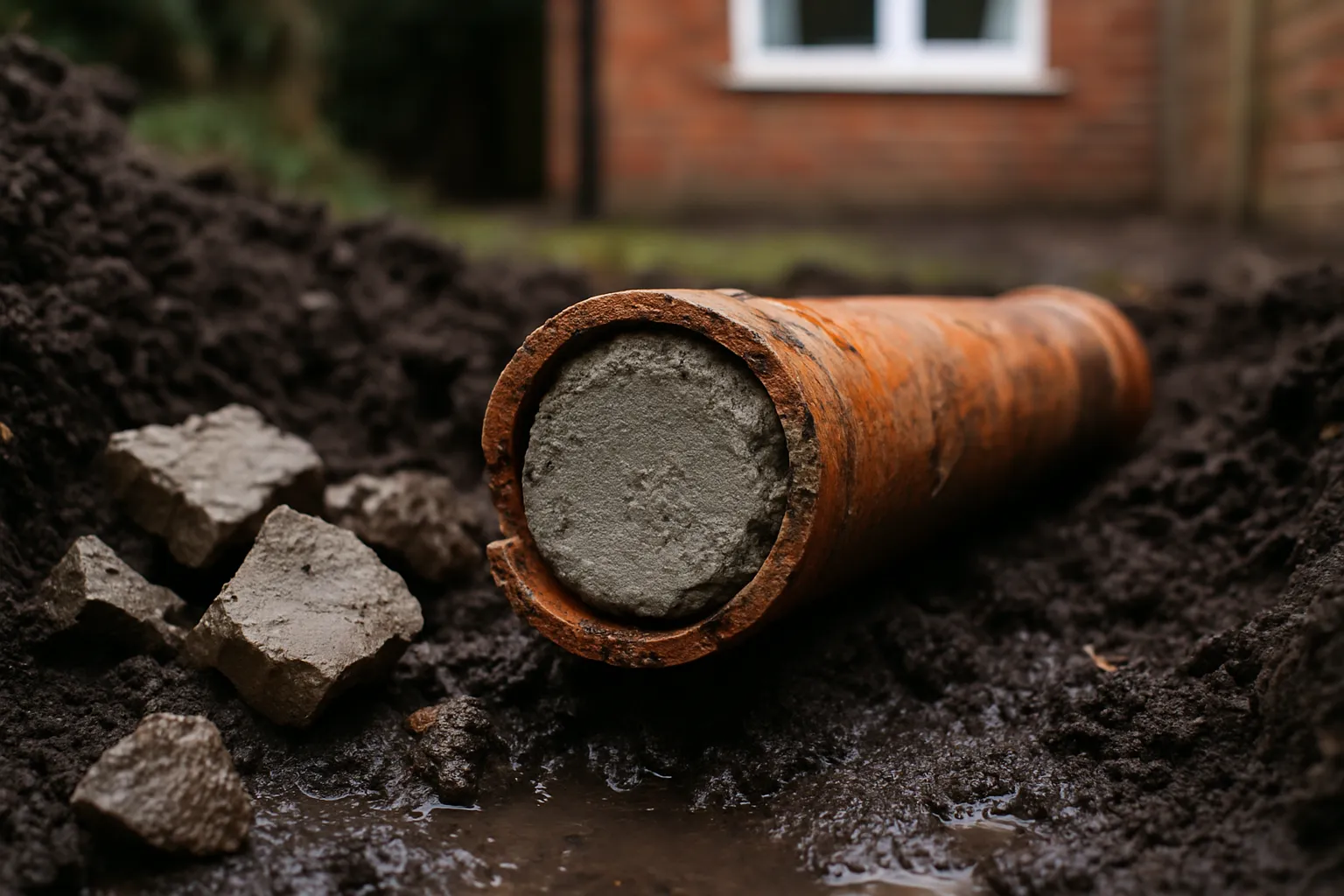
The Renovation That Keeps On Giving
You’ve survived the builders. The kitchen looks brilliant. Then you run the tap and the water just… sits there. Something has set solid in the pipe, and it almost certainly got there during the works.
Washed-out cement in a drain is one of the more quietly spectacular things a CCTV camera reveals. It starts as grey slurry, flows innocently into the pipe while a mixer is being rinsed, and then does exactly what cement is designed to do: it hardens. Sometimes it sets as a partial plug, sometimes it coats the entire pipe wall like a concrete sleeve, narrowing a 100mm drain down to something a pencil would struggle through. Either way, the kitchen is out of action until it is dealt with properly.
We find this genuinely fascinating. You are, understandably, less delighted.
Why Jetting Alone Will Not Shift It
The first instinct is to blast it with a high-pressure water jet. A drain jetter (a machine that fires water at up to 4,000 psi to clear blockages) is brilliant at grease, roots, silt and the average fatberg. It is not a jackhammer.
Hardened cement or mortar in a pipe requires a different approach entirely. Jetting at set concrete without first understanding what you are dealing with risks cracking an already-stressed pipe, which turns a blockage into a structural repair job. The correct sequence is:
- CCTV survey first. A camera goes into the drain to locate the blockage, measure its extent, and check the condition of the surrounding pipe. We need to know whether the pipe itself is intact before anything else happens.
- Mechanical breaking, not jetting. Specialist drain cutting and chiselling equipment, guided by the camera, breaks the concrete into fragments that can then be flushed clear.
- Post-clearance survey. The camera goes back in to confirm the pipe is clear and undamaged.
- Relining if needed. If the pipe wall has been thinned, cracked or weakened, drain relining (a resin-impregnated liner inserted and cured inside the existing pipe, creating a new pipe within the old one) can restore structural integrity without digging up your new kitchen floor.
How Long Does It Actually Take?
A straightforward concrete plug in an accessible section of drain: typically three to five hours on site. A longer set, or one that has affected a junction or a section running under a newly laid floor, can stretch to a full day. In rare cases where the pipe is damaged and relining is required, the job may run across two visits.
That is the honest answer. Anyone quoting you a firm time over the phone before seeing the camera footage is guessing.
Who Is Liable: You or the Builder?
This is the question most people ask first, and it is a fair one.
If the concrete entered the drain during building works carried out by a contractor, the liability almost always sits with that contractor. Rinsing cement mixers, boards and tools into a drain is a breach of standard practice and, depending on the volume, potentially an environmental offence.
Practically speaking, that means:
- Document everything. Photographs of the blockage, the CCTV footage, the date works were completed and the date the problem appeared all matter if you pursue a claim.
- Get the CCTV report in writing. A professional drain survey report identifying cement or mortar as the cause of blockage is the evidence you need.
- Check the builder’s liability insurance. Most reputable contractors carry public liability insurance that should cover exactly this kind of damage. Your own home insurance may also have a trace-and-access clause worth reading.
We can provide a full written survey report suitable for insurance or contractor liability purposes. Ask when you call.
What It Costs (Honestly)
Indicative ranges for work in the TW postcode area:
- CCTV drain survey: roughly £90 to £180 depending on drain length and access
- Mechanical concrete removal (straightforward): roughly £300 to £600
- Drain relining (per metre, if required): roughly £80 to £150 per metre
These are honest ranges, not guarantees. The camera tells us the real number. We will quote clearly before any work begins.
A Note on Health and Safety
If the blockage has caused sewage to back up into the property, treat the affected area as a contamination risk until it has been properly cleaned and disinfected. Raw sewage contains bacteria and pathogens that pose a genuine health risk. Do not use the drain, do not allow children or vulnerable adults near standing waste water, and ventilate the space. A professional clean-down of affected surfaces is not optional.
We Cover Ashford and the Surrounding TW Area
Drainiacs operates 24 hours a day, seven days a week across the TW postcode area, including Ashford, Staines, Shepperton, Sunbury, Feltham and beyond. We aim to be with you within the hour for emergencies, and we carry CCTV equipment on every van so the survey happens on the same visit as the clearance work.
If you have come home from a renovation to a blocked drain, or you are a builder who has just realised what went down the sink, call us now on 07700 137648. The drain is the interesting problem. Getting your kitchen back is the important one.