Emergencies
Drain Collapse Warning Signs: When a Sunken Lawn Means More Than Bad Weather
Sunken lawn, foul smell, slow drains? Learn the warning signs of a collapsed drain in Shepperton and Sunbury, and what to do next.
Published 21 July 2026
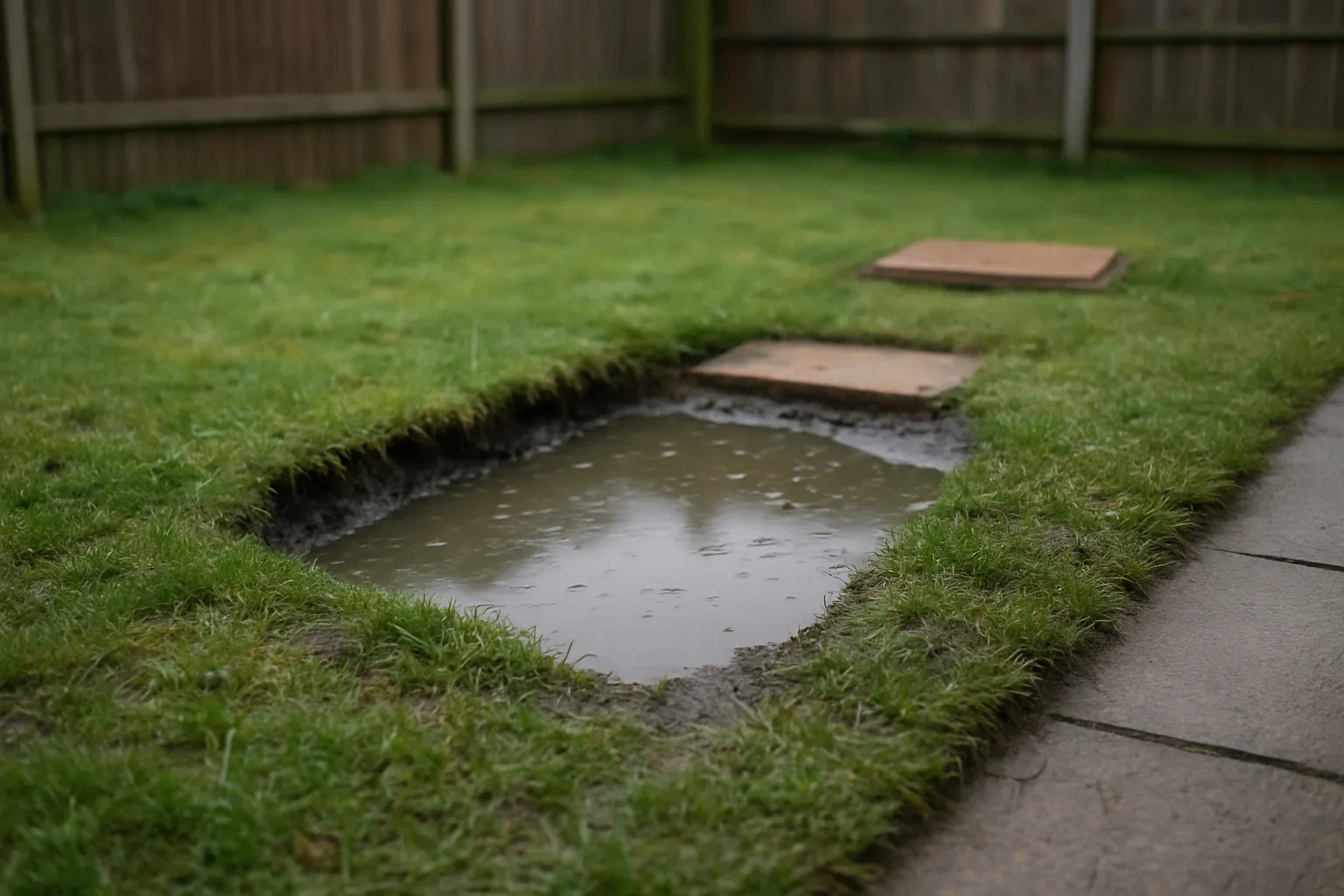
That Dip in Your Lawn Is Trying to Tell You Something
Most people blame the weather. A soggy July, a dry August that cracked the clay, a heavy mower. And sometimes they are right. But if the dip in your lawn keeps coming back, sits above the line of your drains, and comes with a faint smell that no amount of rain seems to wash away, your lawn is not complaining about the weather. It is pointing at something underground.
Drain collapse is more common in Shepperton, Sunbury and the surrounding TW postcodes than most homeowners realise. The older clay and pitch-fibre pipes running under these gardens are now several decades past their expected lifespan. They crack, they sag, they let tree roots in, and eventually sections of them give way entirely. The ground above follows.
Here is how to read the signs before a slow problem becomes an urgent one.
The Warning Sign Cluster
A collapsed or collapsing drain rarely announces itself with a single dramatic event. It builds a pattern. Look for several of these together:
- A sunken patch of lawn or driveway, particularly above the known run of your drainage pipes
- A persistently wet or soft area that does not dry out between rain events
- A foul or sewage smell coming from the garden, not just from inside the house
- Slow drainage from multiple fixtures at once (bath, basin and kitchen sink all sluggish together)
- Repeated blockages that clear temporarily but keep returning within weeks
- Unusual lush growth in one strip of lawn, which can mean effluent is feeding the grass from below
- Cracks appearing in a nearby path or driveway that were not there before
One of these on its own might be nothing. Three or more together, sitting above your drain run, is a strong case for investigation.
What Is Actually Happening Underground
In a partial collapse, the pipe wall cracks or the joint between two sections fails. Soil starts to migrate into the pipe, causing blockages and creating voids above. The ground surface sinks as those voids grow. Water escapes into the surrounding soil rather than flowing to the sewer, which is why the ground stays wet.
In a full collapse, the pipe has lost its shape entirely. Nothing flows through it correctly. Sewage backs up, the surrounding ground becomes saturated with contaminated water, and the void above can grow large enough to become a genuine subsidence risk.
Safety note. Ground saturated with raw sewage contains bacteria including E. coli and other pathogens. Children and pets should be kept away from any persistently wet, foul-smelling area of garden until the source has been confirmed and dealt with. Do not attempt to dig into the area yourself.
What a CCTV Survey Confirms
A CCTV survey is exactly what it sounds like: a small camera is fed through the drain on a flexible rod, recording footage of the pipe interior as it goes. Think of it as a nature documentary, but the wildlife is cracks, root intrusions and sediment fans, and the presenter is genuinely more excited about it than is probably healthy.
What the survey tells you:
- The exact location and depth of any damage
- Whether the pipe has cracked, collapsed, or simply displaced at a joint
- The extent of any root ingress (roots growing in through cracks or joints)
- Whether the rest of the run is sound or showing early-stage deterioration
A survey typically costs in the range of £80 to £200 for a standard residential run in the TW area, and it is the only way to know what you are actually dealing with before committing to repair costs.
Relining or Excavation: How the Decision Gets Made
When relining may work
Drain relining involves inserting a resin-impregnated liner into the existing pipe and inflating it against the pipe walls, where it cures into a smooth, continuous new pipe surface. It is done from access points at either end, with no digging required. This is sometimes called cured-in-place pipe lining, or CIPP.
Relining works well where the pipe is cracked or fractured but still roughly in shape, where the damage is localised, and where the surrounding ground has not shifted significantly. It is generally quicker, cheaper and far less disruptive than excavation. Indicative costs for a residential relining job start from around £500 to £800 for a short run, rising with length and complexity.
When excavation is unavoidable
If the pipe has fully collapsed, if a large section has displaced or bellied (sagged into a dip that holds standing water), or if root damage is extensive, relining cannot fix the underlying problem. The damaged section needs to be dug out and replaced. This is more disruptive and more expensive, with costs varying considerably depending on depth, access and the length of pipe involved. Your drainage engineer will give you a written quote after the CCTV survey.
A Note on Tree Roots in Shepperton and Sunbury Gardens
Both areas have mature trees, and mature trees have extensive root systems that follow water. Clay pipes with even a hairline crack are an invitation. Root ingress (roots growing inside the pipe) can cause repeated blockages for years before the pipe finally fails. If your CCTV survey shows root intrusion, that is useful information even if the pipe is not yet collapsed, because it tells you the pipe is already compromised and the clock is running.
What to Do Now
If you recognise two or more of the warning signs above, the sensible next step is a CCTV survey to establish exactly what is happening. It is not an emergency in itself, but it is not something to leave until next spring either. A partial collapse becomes a full one on its own schedule, not yours.
If you are already seeing sewage backing up inside the property, the ground is actively sinking, or the smell is strong and persistent, treat that as urgent.
Call Drainiacs on 07700 137648, any time, day or night. We cover Shepperton, Sunbury and the full TW postcode area, and we would genuinely rather look at your drain than not.
A sunken patch can also be a leaking supply pipe rather than a drain. Our sister plumbing firm Emergency Plumbers TW explain how they find a water leak under the house.