Local
Whitton Drainage Guide: The High Street, the Terraces and the Pipes Beneath
Whitton's interwar terraces share more pipework than you'd think. Here's what that means when a drain blocks and who to call first.
Published 5 July 2026
Whitton’s Drains: A Surprisingly Sociable Network
Whitton is easy to underestimate. Tucked between Twickenham and Hounslow, it has a high street, a good few pubs, and row after row of interwar terraces that were built quickly, built cheaply, and built with drainage systems that were never really designed for twenty-first century living. Those pipes are still down there. And they are, in a word, chatty.
If you have a blocked drain in Whitton right now and you need someone out fast, call 07700 137648. We cover Whitton around the clock.
If you have a few minutes and want to understand what is probably going on under your garden path, read on.
The Interwar Terrace Problem
The streets running off Whitton High Street, Nelson Road, Kneller Road, Percy Road and their neighbours, were mostly built between the wars. The houses went up in runs of six, eight, ten at a time, and the drains were laid to match: a single shared lateral (that is, a pipe running under the back gardens connecting several houses to the main sewer) serving a whole terrace row.
This was perfectly sensible in 1932. It is slightly less sensible now, because it means your drainage is not entirely your own business.
What “Shared Lateral” Actually Means
A shared lateral is a private drain that serves more than one property before it connects to the public sewer. Thames Water own the public sewer in the road. You and your neighbours jointly own the shared lateral. When it blocks, whoever notices it first tends to ring a plumber, but the problem, and the cost, may well belong to all of you.
Indicative cost for clearing a shared lateral blockage: roughly £150 to £350 depending on access and severity. If the lateral needs a CCTV survey (a camera sent down the pipe on a cable, so you can see exactly what is wrong and where), add £100 to £200 for that.
Who Is Responsible for What
This is the question that causes more arguments between neighbours than almost anything else in drainage, so here it is plainly.
- Your private drain: the pipe that runs from your house to where it first meets a shared pipe or the public sewer. Entirely your responsibility.
- A shared lateral: the pipe serving two or more properties. Jointly owned by those properties. Thames Water are not responsible for it.
- The public sewer: Thames Water’s problem, not yours. If the blockage is in the public sewer, report it to Thames Water and do not pay anyone to fix it.
A CCTV survey is usually the quickest way to settle which category a blockage falls into. It takes around 30 to 45 minutes on a typical Whitton terrace property, and the footage is yours to keep, which matters if you need to involve neighbours or insurers.
What the Camera Tends to Find in Whitton
Speaking as someone who finds drain surveys genuinely compelling viewing, here is what comes up most often in this part of TW2.
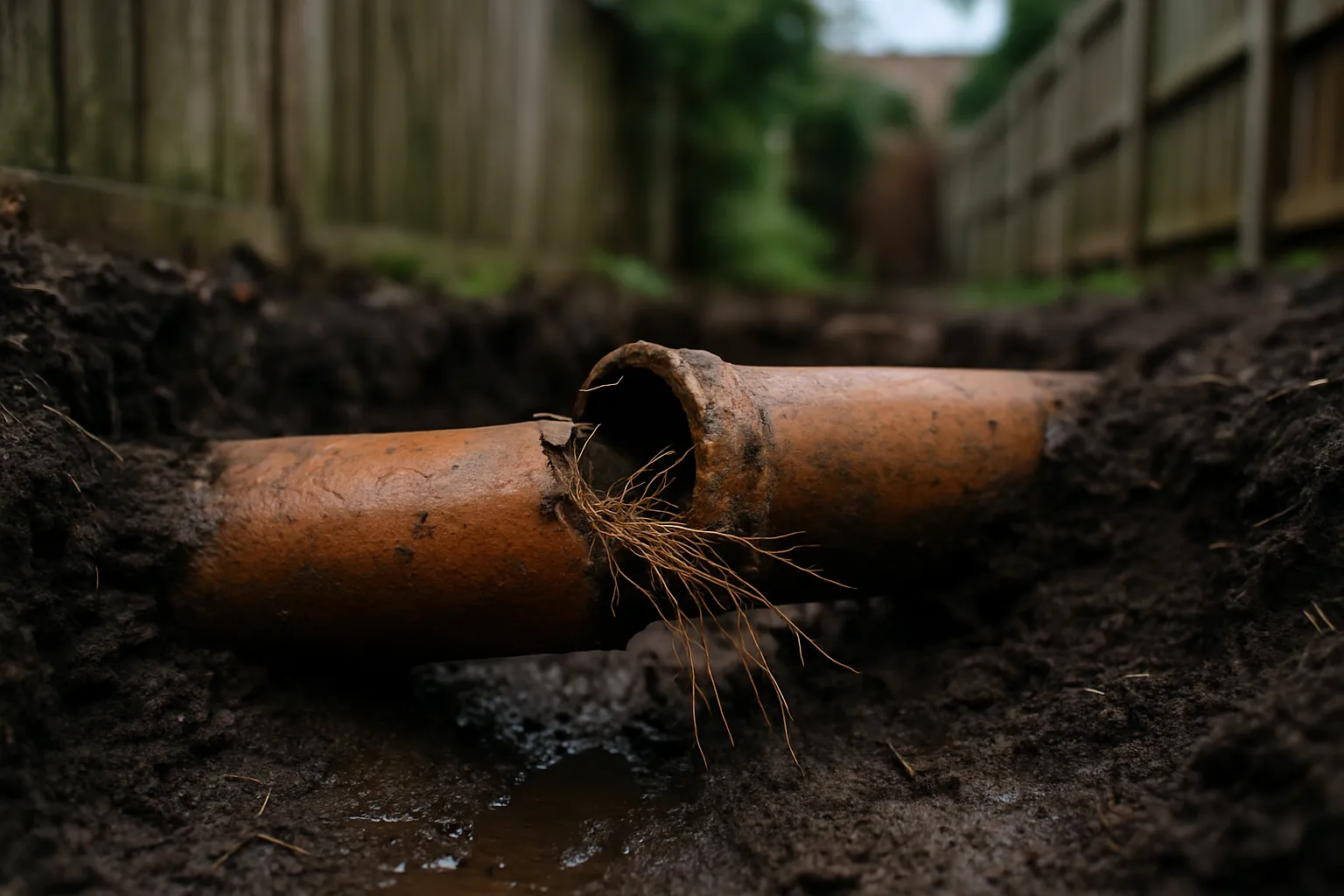
Root ingress. The mature trees along many of Whitton’s residential streets have had decades to find the hairline cracks in clay pipe joints. Fine roots get in, catch passing debris, and gradually build a blockage that feels, on camera, like a tiny but determined forest. Root ingress means the pipe needs clearing and the joint needs attention, or the roots will be back within a year or two.
Grease and fat accumulation. The pipe does not care that it was not your cooking fat. It accumulates from every house upstream of you, and in a terrace row that can be considerable. A high-pressure water jetter (a machine that fires water at up to 4,000 psi through a nozzle in the pipe, blasting the blockage apart) clears this quickly. Typical cost for a jetting visit: £100 to £250.
Collapsed or displaced pipe sections. Older clay pipes settle over time, especially under gardens that have had patios, extensions or heavy vehicles driven over them. A displaced joint (where two pipe sections have shifted apart) creates a step that catches everything passing through. This needs either excavation or pipe relining (a resin sleeve inserted inside the existing pipe and inflated to form a new smooth bore, without digging). Relining a short section typically costs £500 to £1,500 depending on length and access.
The High Street Connection
Whitton High Street sits above a larger Victorian sewer that feeds into the wider Thames Water network. Properties on or immediately behind the High Street sometimes connect to this older infrastructure rather than the interwar laterals. Older does not always mean worse, but it does mean different failure modes: more likely to be brick-built, more likely to have root damage at mortar joints, and more likely to contain an interceptor trap (a sealed chamber designed to stop sewer gases travelling back up the pipe into the house, common in pre-1960s drainage).
Interceptor traps block easily and are often the first thing to check when a ground-floor drain backs up slowly rather than suddenly.
A Note on Health and Safety
Raw sewage backing up into a property is a health hazard. It contains bacteria including E. coli and other pathogens. If sewage is visible inside your home, keep children and pets away from the affected area, do not use any drainage in the property until the blockage is cleared, and wash hands thoroughly after any contact. This is not a situation to leave until morning.
What to Do Right Now
If you have a blocked drain in Whitton, the sensible order of operations is:
- Check whether it is one drain or all drains. One slow sink is probably a local blockage. Everything backing up at once suggests the shared lateral or the public sewer.
- Check your neighbours, if it is safe and convenient to do so. If they have the same problem, the blockage is downstream of where your drains join.
- Call us. We will tell you over the phone what is likely going on and get an engineer to you.
We are available 24 hours a day, seven days a week, across Whitton and the surrounding TW postcodes. If you are dealing with a drainage emergency right now, call 07700 137648.
If the damp patch turns out to be a leaking pipe rather than a drain, our sister plumbing firm Emergency Plumbers TW offer leak detection in Whitton.