Local
Twickenham Drains: What Rugby Weekends Do to the Town's Sewers
80,000 extra flushes in an afternoon. Here's what match-day crowds do to Twickenham's drains, which streets feel it first, and what to do if yours blocks.
Published 13 July 2026
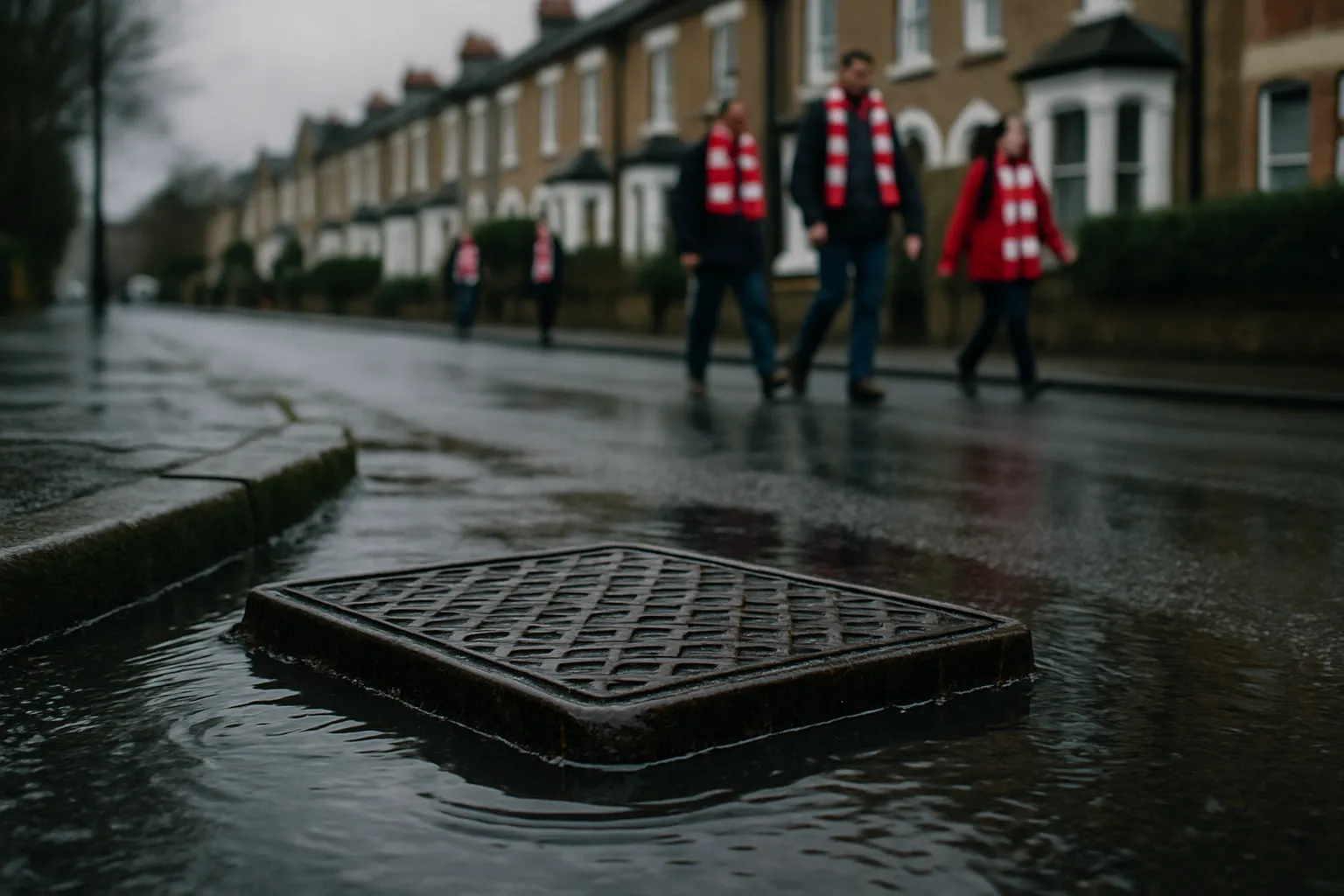
Eighty Thousand Extra Flushes
Twickenham Stadium holds around 82,000 people. On a sold-out Six Nations afternoon, those 82,000 people eat pies, drink beer, and then, at half-time, they all do the same thing at exactly the same time. The maths is not complicated. The results, for the Victorian-era sewer network running under the streets of TW1 and TW2, are spectacular.
I say spectacular. I mean that in the way a volcanologist means it. Awe-inspiring. Professionally fascinating. Quite destructive if you happen to live nearby.
Here is what actually happens underground, and what it means for your kitchen sink.
How the Surge Works
The stadium has its own internal drainage. The problem is what happens the moment that water leaves the stadium boundary and meets the shared public sewers under Rugby Road, Whitton Road, and the residential streets fanning out towards St Margaret’s and Twickenham Green.
Those sewers were engineered for the population that existed when they were laid, not for a twice-monthly population spike of 80,000. When a wave of wastewater hits a network that is already carrying normal Sunday-afternoon load, it does not politely queue. It slows. It backs up. And it looks for the nearest low-resistance exit, which is often the U-bend under someone’s kitchen sink, or the drain gulley in someone’s back garden.
This is called hydraulic surcharge (the sewer fills above its normal capacity and pressure builds in the lateral pipes connecting your property to the main). It is a known, documented phenomenon in high-footfall areas, and Twickenham is one of the clearest examples in South West London.
Which Streets Feel It First
Based on the network layout and the calls we take on match days, the areas most likely to see slow or blocked drains in the hours after kick-off include:
- Rugby Road and the streets directly east of the stadium. Closest to the surge origin, lowest elevation in places.
- Whitton Road corridor towards Whitton village. A long, busy lateral that carries both residential and commercial load.
- Arragon Road, Amyand Park Road, and the St Margaret’s end of Richmond Road. These connect to older combined sewers (pipes that carry both surface water and foul water in the same channel) that have less spare capacity.
- Cole Park Road and Marble Hill area. Lower-lying ground means backpressure finds these connections more easily.
If you live within roughly half a mile of the stadium and your drains run slowly on match days, you are not imagining it and there is nothing wrong with your pipes specifically. You are experiencing the sewer equivalent of a traffic jam.
What This Means Practically
A hydraulic surge blockage usually clears on its own once the peak passes, typically two to four hours after the final whistle. If your sink is draining slowly but still draining, the sensible move is to run minimal water, avoid putting anything extra down the drain, and wait.
However, if you see any of the following, call us immediately rather than waiting it out:
- Water or sewage backing up into a ground-floor toilet, bath or shower tray
- A drain gulley in your garden overflowing
- Any smell of sewage inside the property
- Gurgling from multiple fixtures at once (that pattern suggests the blockage is in the shared drain, not just one branch pipe)
Those signs mean the pressure has found a way into your property rather than simply slowing things down. That moves it from an inconvenience into a health issue.
A Note on Health Risks
Raw sewage contains bacteria including E. coli and other pathogens. If sewage has backed up into your home, do not let children or pets near the affected area. Wear gloves if you need to move anything. Open windows. Do not use the affected fixtures until the blockage is cleared and the area has been properly cleaned and disinfected. This is not a job to leave until Monday morning.
What We Do When We Arrive
For a match-day surge blockage, the first tool out of the van is usually a high-pressure water jetter (a machine that fires a focused jet of water through the pipe at high pressure to break up and flush the blockage). If the blockage is further into the shared drain, we carry a CCTV drain camera, which is a small waterproof camera on a flexible cable that we feed into the pipe to see exactly what is happening and where.
Indicative costs for a standard drain unblocking in Twickenham run from around £80 to £200 depending on the severity and access. A CCTV survey on top of that typically adds £100 to £200. We will always tell you the likely cost before we start work.
We cover TW1 and TW2 around the clock, including during matches and immediately after. Typical arrival time in Twickenham is 45 to 90 minutes for an emergency call.
The Bigger Picture
None of this is a criticism of the stadium or the event. Eighty thousand people turning up to watch rugby is one of the genuinely great things about living near Twickenham. The sewer network is just doing its best with a brief it was never designed for, and occasionally it needs a hand.
We find that hand professionally satisfying to provide.
If your drains are blocked or backing up in Twickenham, call us on 07700 137648. We are available 24 hours a day, every day, including match days.