Local
Isleworth Drains Explained: From the London Road to the Duke's River
Blocked drain in Isleworth? Local guide to what blocks where, the quirks of the Duke's River area, and what to do about it. Call 07700 137648.
Published 5 July 2026
Isleworth Drains Explained: From the London Road to the Duke’s River
Isleworth is one of those places that looks entirely ordinary until you start digging into what sits underneath it. Victorian terrace streets, 1960s flat blocks, a medieval river channel running through the middle, and a high street that has been quietly accumulating cooking fat since before anyone reading this was born. As a drainage engineer, I find this genuinely exciting. You may not share that enthusiasm right now, which is fine. Let’s get you sorted.
What Makes Isleworth Drains Different
The big geographical fact about Isleworth is the Duke of Northumberland’s River. This is a man-made channel, dug in the sixteenth century to carry water from the Colne to Syon House. It still runs through the area today, passing under roads and gardens before joining the Thames near Isleworth Ait. Properties close to the river, particularly along Twickenham Road and the streets running off it toward the water, sit on ground that is naturally damp. That matters for drainage because:
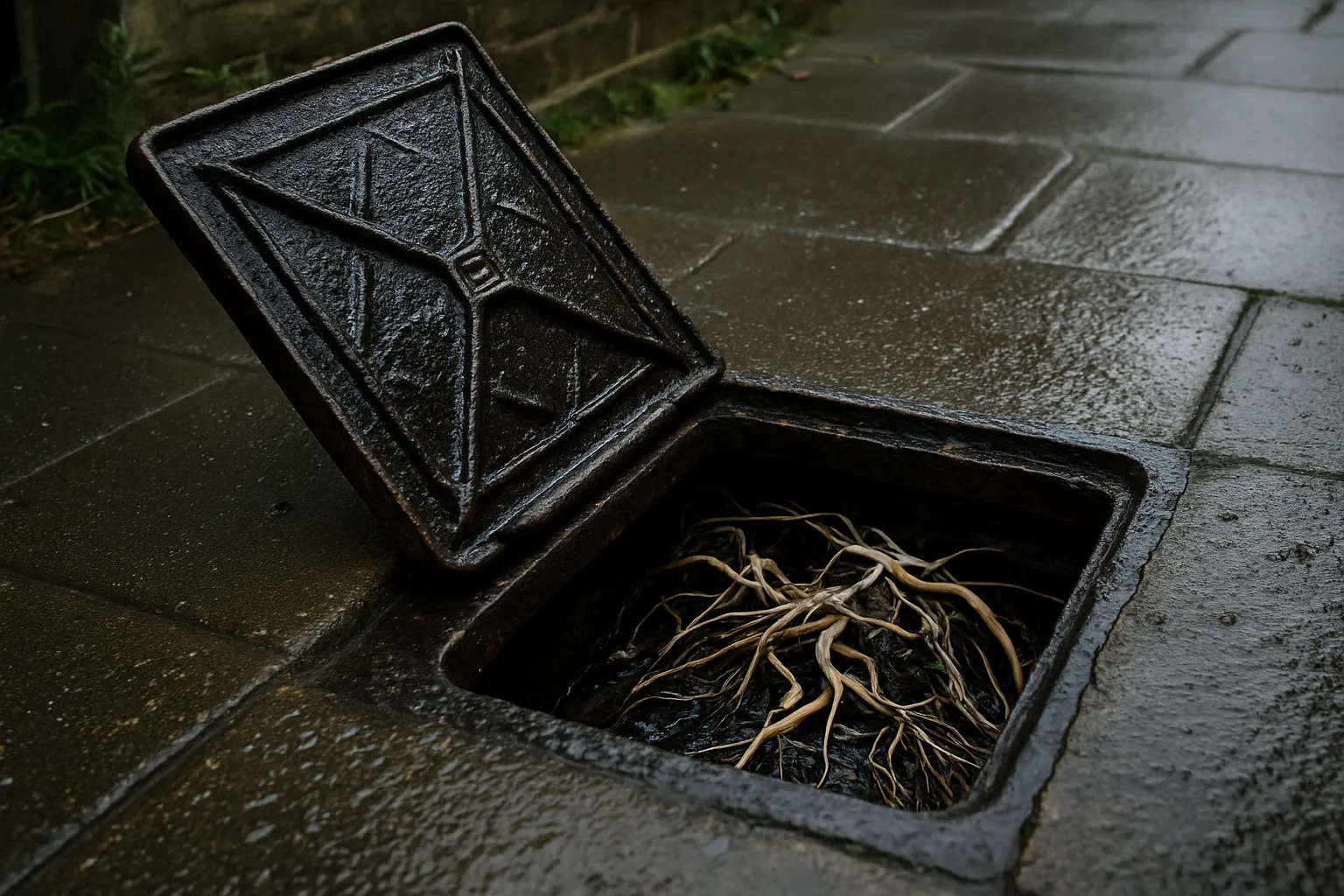
- Tree roots love wet ground. The root systems of riverside trees, willows especially, actively seek out drain joints. Root ingress (where fine roots force their way into a pipe through a joint or crack, then grow into a dense mass that catches everything passing through) is a regular finding on CCTV surveys in this part of Isleworth.
- Ground movement is higher near water. Saturated and then drying clay soil shifts. Older clay pipes shift with it, and joints open up. A CCTV survey (where we send a small camera through your drain on a flexible rod and watch the footage live) often reveals cracked or displaced pipes in gardens that back onto the river corridor.
The Victorian Terrace Belt: London Road and Beyond
The streets between London Road and the High Street, including Twickenham Road, Worton Road and the residential turnings off them, are predominantly Victorian terraced housing. These properties typically have:
- 4-inch clay pipes, often over a century old and never replaced.
- Shared lateral drains, where several houses connect to a single pipe before it reaches the sewer under the road. One house’s blockage can back up into a neighbour’s property.
- Interceptor traps, which are a small water-sealed chamber, usually near the boundary of the property, designed to stop sewer gases coming back up the drain. They were standard Victorian practice. They also catch rags, roots and accumulated grease beautifully, like a tiny underground bin that nobody empties.
Blockages in these streets most commonly occur at the interceptor trap itself, at the connection point where the lateral meets the main sewer, or at bends where grease has built up over years.
The Flats and Newer Builds
Isleworth also has a significant number of post-war and more recent flat developments, particularly toward Busch Corner and along the A315 corridor. Modern plastic pipework is more forgiving than clay, but flat blocks bring their own patterns:
- Shared stacks mean a blockage on an upper floor can affect multiple flats below. If your ground-floor neighbour’s toilet is backing up at the same time as yours, this is almost certainly a shared drain issue rather than anything in your flat specifically.
- Communal bin areas near drain gullies mean outdoor gullies (the small grated drains in car parks and paved areas) regularly fill with food waste, wet wipes and general debris.
What Typically Blocks in Isleworth
In rough order of frequency, based on what the camera actually finds:
- Grease and fat accumulation, particularly on drains serving the High Street and London Road commercial properties, but also in residential kitchens. Fat cools, solidifies and coats the pipe wall. Over months it narrows the bore until almost nothing gets through.
- Root ingress, especially within 20 metres of the Duke’s River and in any garden with mature trees.
- Wet wipes and sanitary products, which do not break down, ever, regardless of what the packet says.
- Collapsed or displaced pipe sections, more common in properties built before 1940.
- Silt and debris in gullies, particularly after heavy rain washes material off the road surface.
What Happens When You Call Us
We cover Isleworth around the clock. For an emergency unblocking, we aim to arrive within the hour. A standard high-pressure water jetting clearance (a powerful, controlled blast of water through the pipe that breaks up blockages and flushes the debris away) typically costs in the range of £80 to £150 for a residential job, depending on access and severity. If the blockage turns out to need a CCTV survey to find the cause, that is usually £150 to £250 and gives you a full recorded report of what is inside your pipes.
If the camera finds root ingress or a cracked pipe, we will explain your options clearly, including drain relining (inserting a resin-coated sleeve inside the existing pipe to seal cracks and restore the bore, without digging up your garden) as well as excavation and replacement where that is the more practical route.
A Note on the Duke’s River Boundary
If you live very close to the river channel itself, it is worth knowing that Thames Water and the Environment Agency both have jurisdiction over different parts of the watercourse. We can clear and survey your private drain up to the point where it connects to the public sewer or the watercourse. If there is any suggestion of a drain discharging directly to the river, that is a matter for Thames Water and we will tell you so plainly.
If your drain is blocked right now, do not wait to see if it clears on its own. A slow drain becomes a full backup, and a full backup in an Isleworth terrace can affect your neighbours before morning. Call Drainiacs on 07700 137648, any time of day or night.