How-to
What a CCTV Camera Sees Down a Victorian Drain: A Nature Documentary in Five Acts
Follow a drain camera on its journey through a Victorian sewer in Richmond. Learn what each finding means, what it costs to fix, and when to worry.
Published 5 July 2026
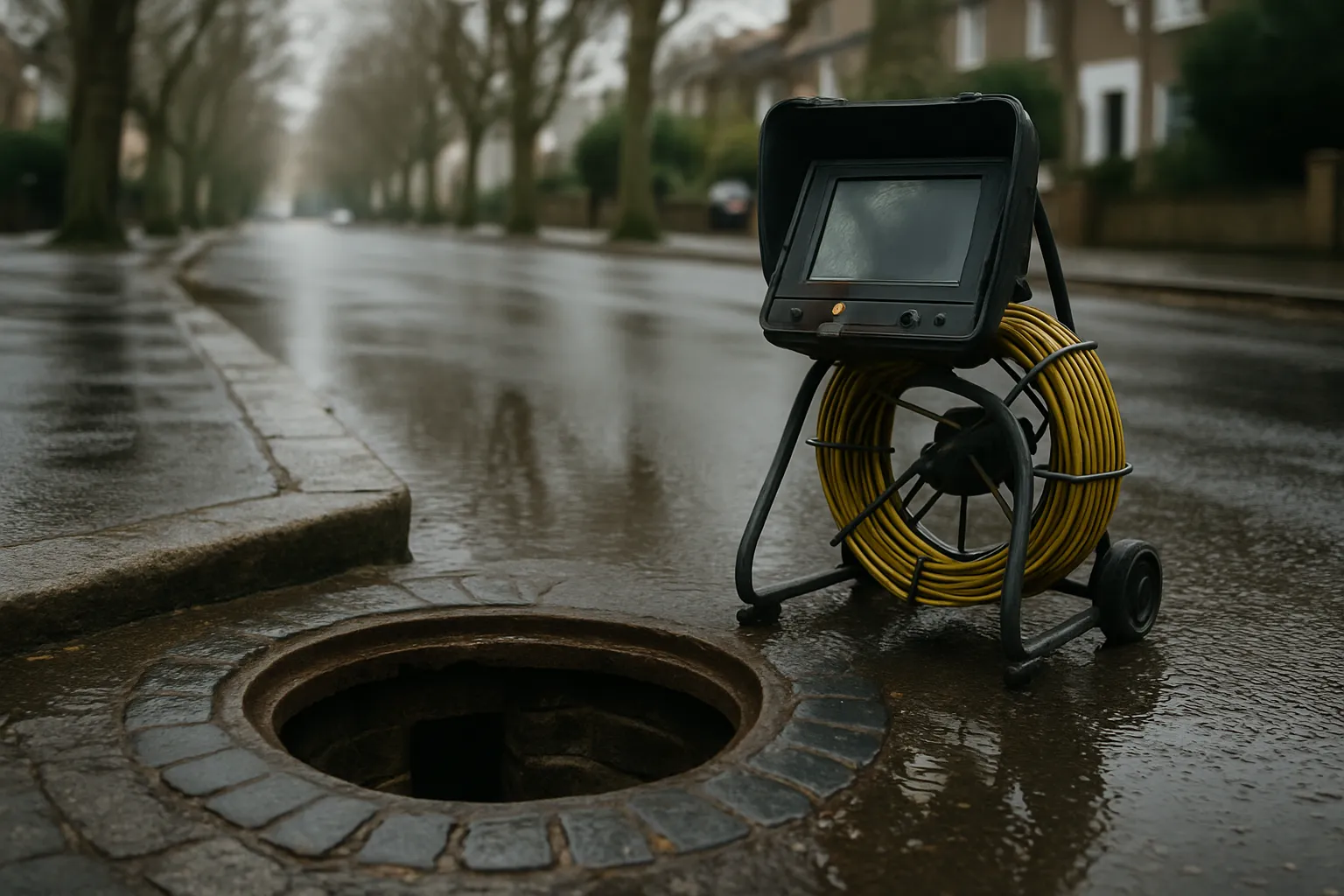
A Nature Documentary in Five Acts
Narrated by someone who has spent an unreasonable number of hours staring at drain footage and is not even slightly sorry about it.
Richmond’s Victorian drainage network is, frankly, a marvel. Laid in the 1870s and 1880s by people who had never heard of wet wipes, it has survived two world wars, several floods, and the invention of the garbage disposal unit. When our CCTV camera enters one of these pipes, it is not merely doing a survey. It is embarking on a journey.
Here is what it finds.
Act One: The Manhole Chamber (The Lobby)
The camera descends into the inspection chamber. This is the entrance hall of your drain’s world. Down here, a good operative is already reading the story: is there standing water? A grease tide-mark? The faint, sulphurous atmosphere of something that has been sitting for a while?
Victorian chambers are often built from blue engineering brick, and they are beautiful in a damp, subterranean way. They are also where you will find the interceptor trap (a U-shaped dip in the base of the chamber, designed to stop sewer gases travelling back up toward your house). If that trap is blocked, you will know about it. The whole chamber fills, slowly and with commitment.
What it costs if the trap is blocked: clearing an interceptor trap typically runs between £80 and £200, depending on how determined the blockage is.
Act Two: The First Straight Run (The Open Savannah)
The camera moves forward. In a well-maintained Victorian drain, this stretch is almost calming. Egg-shaped pipe, usually six or nine inches across, still doing its job after 150 years. Respect.
But watch the joints. Victorian pipes were laid in short sections with mortar joints, and those joints have had a century and a half to shift, crack, and invite guests. The camera will show:
- Displaced joints: sections that have moved slightly out of alignment, creating a small lip that catches debris.
- Hairline cracks: cosmetic now, structural later.
- Infiltration: groundwater seeping in through a crack, which looks on camera like a tiny underground spring and is, objectively, quite pretty. It is also a problem.
Displaced joints and minor cracks can often be repaired by drain relining (a process where a resin-coated sleeve is inserted and inflated inside the existing pipe, creating a smooth new pipe within the old one, without any digging). Cost for a standard relining job on a domestic drain: roughly £600 to £1,500 depending on length and access.
Act Three: The Root Fringe (The Jungle)
Here is where things get cinematic.
Tree roots enter drains through cracked joints, and they do not do it aggressively. They do it gently, patiently, over years, following the moisture. By the time the camera finds them, they have often formed what can only be described as a curtain: a pale, hair-fine fringe hanging from the top of the pipe, swaying slightly in the flow.
It is genuinely one of the most extraordinary things a drain camera sees. It is also genuinely one of the most destructive things that can happen to a drain.
Root ingress (tree roots growing into the pipe) starts as a nuisance and ends as a structural failure if left alone. The roots catch tissue, grease, and debris, building a blockage from the inside out.
Richmond and Twickenham are full of mature street trees, which is wonderful for the borough and challenging for the drains beneath it. We see root ingress regularly in TW9, TW10, and the older residential streets around Richmond Green.
Treatment: high-pressure water jetting to clear the immediate blockage, followed by relining or targeted excavation if the pipe is structurally compromised. Budget from £150 for a jet-and-clear, rising to £2,000-plus if excavation is needed.
Act Four: The Misty Bit (The Atmosphere)
Every experienced drain camera operator knows this moment. The lens fogs. The image goes soft and impressionistic. Something is happening ahead.
Usually it is one of three things:
- A partial blockage creating a pool of warm, humid air. Unpleasant, fixable.
- A collapsed section, where the pipe has failed entirely and the camera is looking at compacted earth. This is the serious one.
- A change in pipe material, where a Victorian clay pipe meets a later addition in pitch fibre or plastic, and the junction has not aged gracefully.
A collapsed drain is a safety and structural matter. If the collapse is beneath a driveway, patio, or, in the worst cases, a building’s foundations, this moves beyond drainage into subsidence territory. At that point, the survey report becomes important documentation for your insurer and your structural engineer.
Act Five: The Outfall (The Sea)
The camera reaches the connection to the public sewer, or in some older Richmond properties, a soakaway (a rubble-filled pit that allows water to drain slowly into the surrounding ground, which works well until it doesn’t). This is the end of your private drain and the beginning of Thames Water’s responsibility.
Knowing exactly where that boundary sits is one of the most practically useful things a CCTV survey tells you, because it determines who pays for any repair beyond that point.
What a Survey Costs and How Long It Takes
A standard domestic CCTV drain survey in the TW area costs between £120 and £300. You receive a written report and, with most operators, a video recording. The survey itself takes one to two hours on a typical Victorian terraced property.
It is worth doing before you buy any property built before 1950. It is essential if you have recurring blockages, slow drainage, or unexplained damp near a drain run.
Straight Talk Before You Go
Victorian drains are tough, but they are not immortal. A CCTV survey does not fix anything. What it does is tell you exactly what you are dealing with, so that repairs are targeted rather than guesswork. That information saves money.
If you are in Richmond, Twickenham, Teddington, or anywhere across the TW postcode area and you need a survey booked, or if you have a live blockage that cannot wait, call Drainiacs on 07700 137648. We are available around the clock.