How-to
Drain Surveys Before Extensions: Mapping, Build-Over Evidence and CCTV
How to map drains, get CCTV evidence and satisfy Thames Water or building control before your TW extension breaks ground.
Published 21 July 2026
Before Anyone Lifts a Spade
You have planning permission. The builder is booked. The kitchen extension is happening. Brilliant. Now, somewhere under your garden, a Victorian clay pipe is minding its own business, completely unaware that a concrete foundation is about to land on top of it. That pipe does not care about your planning permission. That pipe does not care about your builder’s start date. That pipe will, however, care enormously when it cracks, backs up, and sends raw sewage into your new utility room.
This guide walks you through the sequence: work out what kind of pipe you have, map where it runs, inspect it with CCTV, gather the evidence Thames Water or building control may require, and keep records for after the build. It is aimed at anyone extending a TW-postcode property, especially the terraced and semi-detached Edwardian and Victorian stock across Twickenham, Whitton, Isleworth and Brentford where older clay drains run in directions nobody ever wrote down.
Step One: Public Sewer or Private Drain?
This distinction matters more than anything else in this guide.
A private drain carries waste from your property only. You own it, you maintain it, you can build over it if you and your building inspector are comfortable with the structural design. A public sewer carries waste from two or more properties. Thames Water owns it. Building over or near it without permission is a different matter entirely.
In 2011, most shared private sewers were transferred to Thames Water ownership. Many homeowners in TW postcodes still do not know which category their pipe falls into. The quickest way to find out is to check the Thames Water sewer map (available via their website), then cross-reference with the drainage layout on your property’s original build drawings if you have them.
If the map is ambiguous, or the pipe is old enough that records are incomplete, a CCTV survey combined with a dye test will tell you what connects to what.
Step Two: Map the Route Before Anyone Digs
Knowing a pipe exists is not the same as knowing where it runs. In older Twickenham terraces, drains sometimes cut diagonally across gardens, follow the line of a long-demolished outbuilding, or share a single access chamber with the neighbour’s system. None of this appears on a standard sewer map.
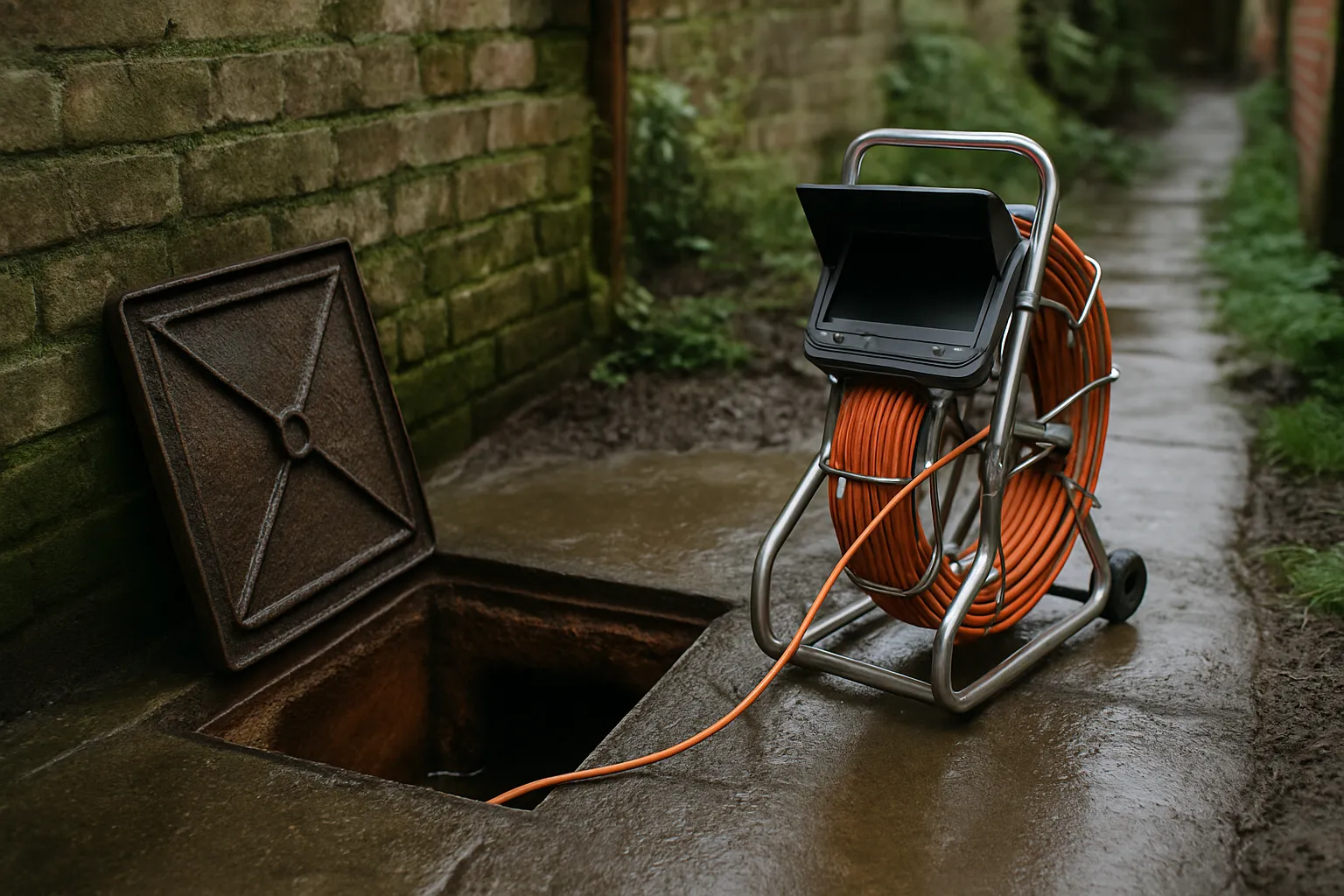
Drain mapping (sometimes called a drainage trace) uses a combination of CCTV camera footage, a radio-frequency transmitter pushed through the pipe, and a surface locator to mark the actual route on the ground. The result is a scaled plan showing depth, direction, access points and the location of any junctions.
That plan is what your structural engineer needs to design foundations that avoid or safely span the pipe. Without it, they are guessing.
Step Three: CCTV Inspection and Condition Report
Once you know where the pipe is, you need to know what state it is in. A CCTV survey sends a camera through the drain and records everything: cracks, root ingress (tree roots growing through pipe joints, which is extremely common near the mature street trees in Richmond and Twickenham), displaced joints, collapsed sections, and the general profile of the pipe.
The camera operator logs defects against a standard grading system. You receive a DVD or digital file of the footage and a written report grading each defect.
Why does condition matter before a build? Because Thames Water, and many building control officers, want to know the pipe is structurally sound before they agree to anything being built near or over it. A pipe already showing grade 4 or 5 defects (significant structural failure) will need repair or relining before any build-over conversation can happen. Relining means inserting a resin-impregnated sleeve inside the existing pipe and inflating it to cure in place, forming a new pipe within the old one, without digging up the garden.
Discovering this before you pour concrete is considerably better than discovering it afterwards.
Step Four: Build-Over Agreements and Building Control Evidence
If the pipe under your proposed extension is a public sewer, you will almost certainly need a build-over agreement with Thames Water before work starts. The specific requirements depend on the diameter of the sewer, the depth, the type of structure proposed, and the proximity of the foundation to the pipe centreline.
This guide will not attempt to summarise those rules in detail, because they are updated periodically and the consequences of getting them wrong are serious. Go to the current Thames Water build-over guidance directly and read it, or ask a drainage engineer to walk you through what applies to your specific situation.
What CCTV gives you in this context is the pre-construction condition record. Thames Water typically requires a CCTV survey before granting a build-over agreement, and they will want a post-construction survey to confirm the pipe was not damaged during the build. The pre-build footage is your baseline. Keep it.
Step Five: Post-Build Survey
Once the extension is complete, a second CCTV pass confirms the pipe is in the same condition it was before work started. This protects you from any future claim that your builder damaged the sewer, and it satisfies the post-construction requirement in most build-over agreements.
File the pre-build report, the post-build report, the build-over agreement (if applicable) and the drainage plan together. If you ever sell the property, a buyer’s solicitor will ask for them.
Timing and Cost
Book the survey before your structural engineer finalises the foundation design, not after. In the TW area, a CCTV survey with mapping and a written condition report typically runs from around £250 to £600 depending on the length of pipe, number of access points and whether a locator trace is needed. Costs for relining or repair work before a build-over application are separate and depend entirely on what the camera finds.
If you are about to start an extension in the TW area and have not yet had the drains surveyed, or if you have just discovered a pipe running exactly where your foundations need to go, call Drainiacs on 07700 137648. We cover Twickenham, Richmond, Hounslow, Feltham, Ashford, Staines, Shepperton, Sunbury, Hampton, Teddington, Whitton, Isleworth and Brentford, and we can get a camera in the drain and a report in your hands before your builder’s deadline becomes a problem.