How-to
Can You Have a CCTV Drain Survey Without a Manhole?
No manhole? A CCTV drain survey is still possible in the TW area. Find out how engineers access your drains and what changes the quote.
Published 2 August 2026
The manhole question that stops homeowners in their tracks
You need a CCTV drain survey. Maybe you are buying a house, chasing a recurring blockage, or your insurer has asked for evidence. You walk around the garden, peer under the decking, check behind the bins, and find: nothing. No manhole cover. No inspection chamber. Just lawn.
Here is the good news: the camera still goes in. It just goes in a different way, and the engineer needs to know about the access situation before arriving so they can quote accurately and bring the right kit.
What a CCTV survey actually involves
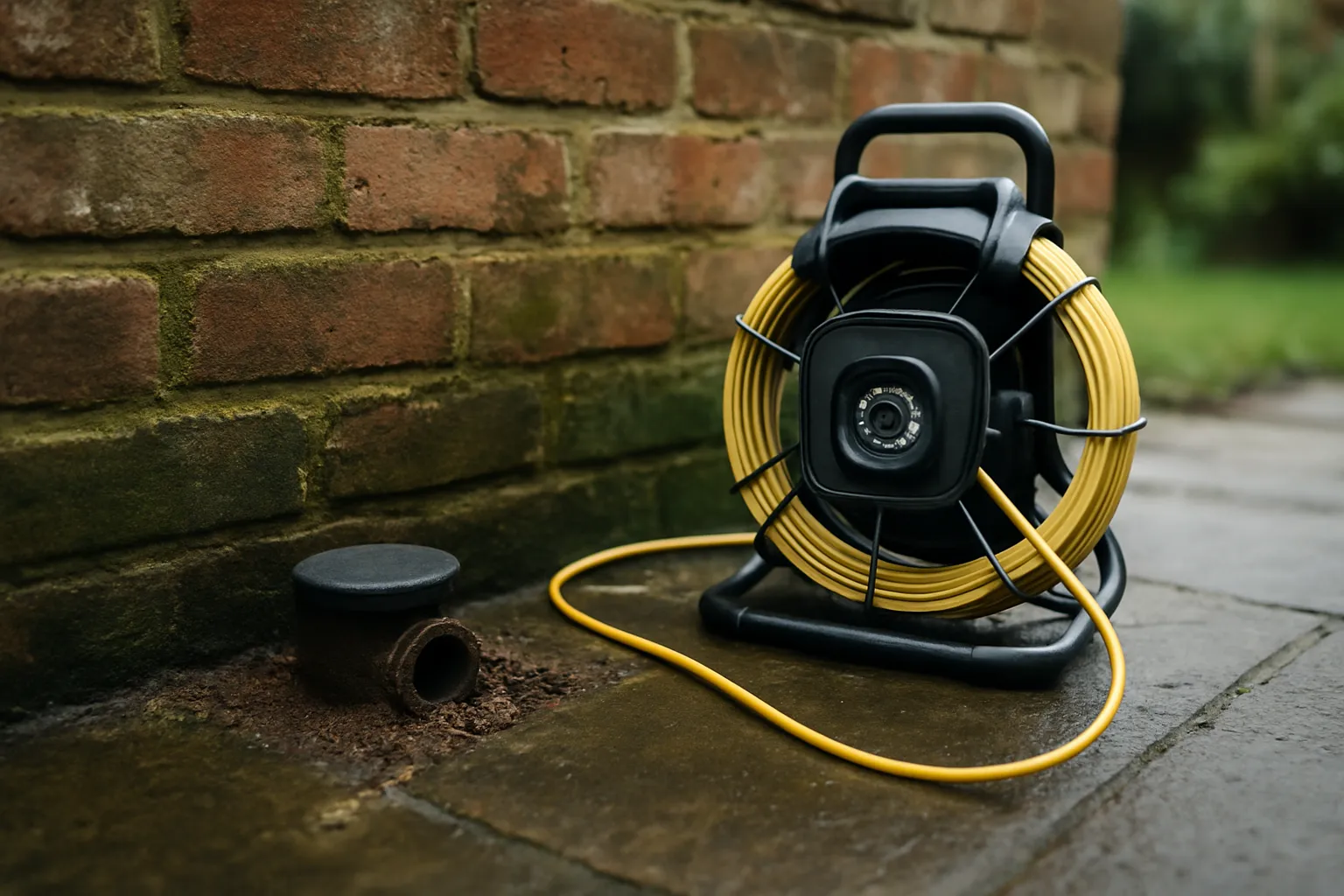
A CCTV drain survey means pushing a small, waterproof camera along the inside of your drain pipe, recording everything it finds. Think of it as a nature documentary inside your pipework. The camera needs an entry point, not necessarily a manhole.
A manhole (also called an inspection chamber) is simply the most convenient entry point because it is large, designed for access, and lets the engineer work comfortably. Without one, the survey is not cancelled. It is adapted.
Alternative access points engineers use
Rodding eyes
A rodding eye is a small capped pipe, usually 100 mm or 150 mm in diameter, that sticks up from the drain line and is designed precisely for situations like this. It is the drain equivalent of a side door. Many properties built after the 1980s have them instead of, or in addition to, traditional manholes. They are often tucked against a wall, under a bush, or hidden at ground level. Your engineer will look for these first.
Gully pots
The grid-covered pots at the base of your downpipes and in your yard collect surface water before it enters the underground drain. A camera can enter here, though the angle and depth it can reach may be more limited than from a chamber. For shorter runs or shallow drains, a gully survey is often enough to answer the question at hand.
Internal soil stacks
A soil stack is the large vertical pipe, usually 100 mm in diameter, that carries waste from your toilets, baths and sinks down through the building and into the underground drain. With the right adaptor, the camera can enter the stack from inside the property, typically at a ground-floor access point or a cleanout plug. This is a completely standard technique and causes no disruption to the pipe itself.
Sonde tracing
Once the camera is inside the pipe by any route, it can carry a small transmitter called a sonde (pronounced “sond”). A handheld receiver above ground picks up the signal and lets the engineer trace the pipe route and depth across your garden, under your patio, or beneath your extension. This is how buried drain layouts get mapped without digging anything up.
What if there is genuinely no access point at all?
Occasionally a property has no rodding eye, no accessible gully, and no practical internal entry. In that situation the engineer will discuss two options with you.
First, a carefully created access point. Cutting a small opening into an existing pipe and fitting a proper access fitting is a minor piece of work. It leaves you with a permanent, useful entry point for any future surveys or clearances, which has real value in itself. This adds cost, and the engineer will quote for it separately before proceeding.
Second, a partial survey. If the problem area can be reached from one end even if not the other, a partial survey may still answer the specific question, such as confirming whether a blockage exists or whether a particular section of pipe is structurally sound.
How access scope changes the quote
A standard CCTV survey from a clear manhole is the simplest, fastest job. Every variation on that adds time and sometimes specialist equipment.
As a rough guide for the TW area, a straightforward survey from a manhole typically runs from around £100 to £200 for a residential drain. Add alternative access work, sonde tracing across a large plot, or a new access fitting, and the figure rises accordingly. The engineer cannot give a firm price without knowing what access exists, which is why describing your situation honestly when you call saves everyone time.
What to check before the engineer arrives
- Walk the full perimeter of the property, including side passages and under any decking, looking for small capped pipes or plastic covers at ground level.
- Check inside the property at ground-floor level for any cleanout plugs on the soil stack, often found in a cupboard under the stairs or in a utility room.
- Note the location of any gully pots, particularly those that seem to connect to the main drain rather than just surface water.
- If you have drainage plans from when the property was built or from a previous survey, dig them out. They will save time on site.
The bottom line
A missing manhole is an access challenge, not a dead end. Engineers working across Twickenham, Richmond, Hounslow, Staines, Hampton, Shepperton and the wider TW postcode area deal with this regularly, particularly on older Victorian terraces and on properties where chambers have been built over during extensions.
If you are not sure what access your property has, or you need a survey arranged quickly, call Drainiacs on 07700 137648. Describe what you can see and the team will work out the right approach before anyone sets off.