Emergencies
Water Pooling Around a Manhole: What the Wet Patch Is Telling You
Standing water near a manhole cover in TW? Learn what causes it, whether it's your responsibility, and when to call a drain engineer.
Published 31 July 2026
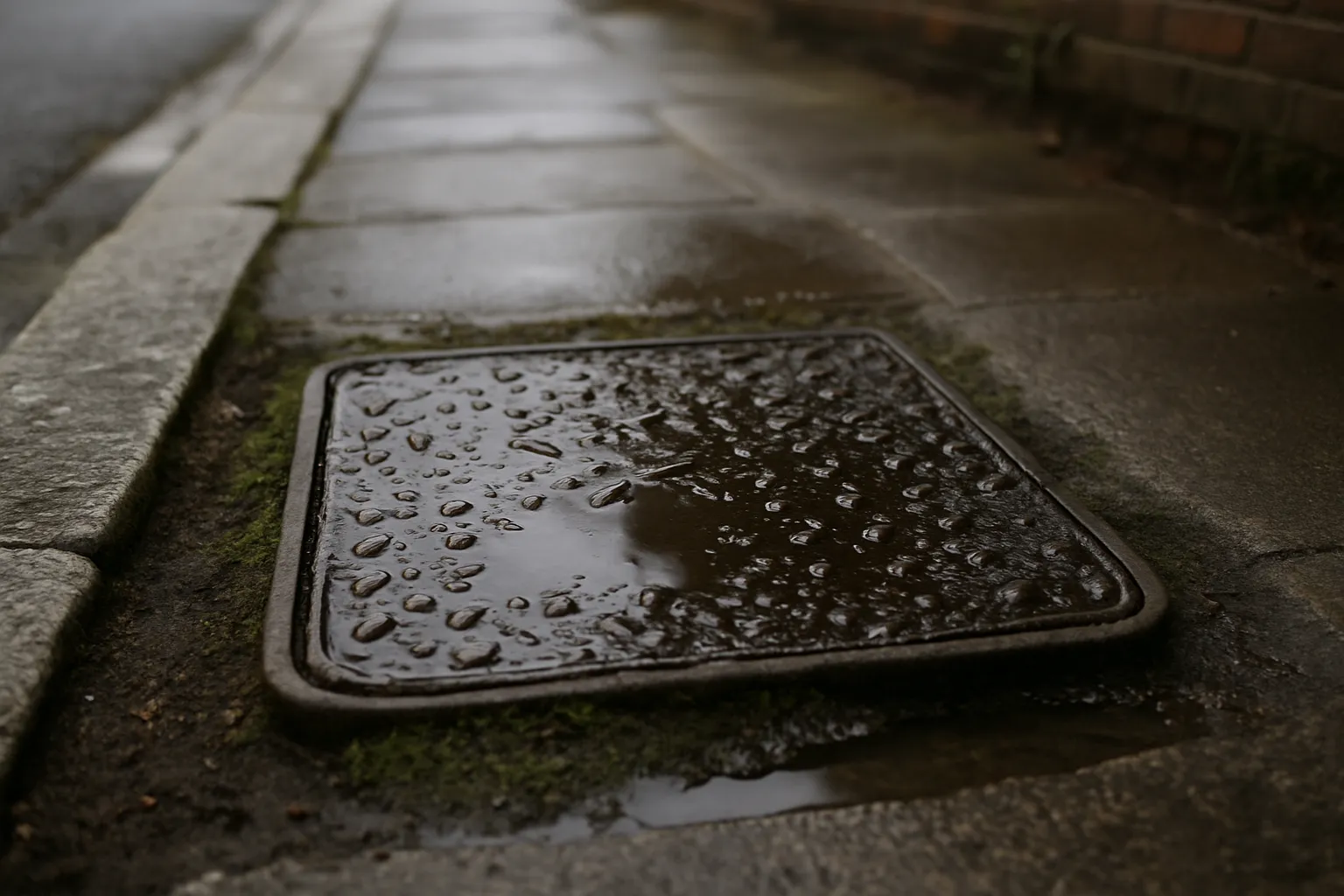
The Ground Is Wet. The Manhole Is Right There. Coincidence?
It is almost never coincidence.
A persistent wet patch around a manhole cover or drainage inspection chamber (that is, the access point that lets engineers look into your underground drain system) is one of the quieter distress signals a drain sends before things get considerably louder and wetter. It does not mean your garden is about to become a sewage lagoon. It does mean something underground is worth investigating before it reaches that point.
This guide walks through the most likely causes, how to tell whether the chamber is your problem to solve, and what to do next.
Five Reasons You Might Have a Wet Patch Near a Chamber
1. A Downstream Blockage Is Backing Water Up
The most common cause. If a blockage sits further along the pipe, water has nowhere to go except backwards. Pressure builds, the chamber fills higher than it should, and water seeps up around the frame and lid. You may not see the chamber actively overflowing, just a damp ring of soil or moss that never quite dries out.
What you might also notice: slow drains inside the house, gurgling sounds from toilets or sinks, or a faint smell near the cover.
2. The Chamber Wall or Benching Has Cracked
Inspection chambers are usually made of brick, concrete or plastic. Brick and concrete chambers can crack over time, especially in older properties. When the chamber itself is fractured, water inside can leak outward into the surrounding soil, which then saturates and shows as a wet patch at ground level. Equally, groundwater can push inward through the same crack, which causes a different problem: ingress water adds volume to your drain that the system was never designed to carry.
3. Root Ingress at the Chamber Joint
Tree roots are, professionally speaking, extraordinary. A fine root tip can find a hairline gap at the joint where a pipe meets a chamber wall, and within a season or two that gap is a root mass the width of your forearm. Roots at a chamber joint can hold the joint slightly open, allowing both leakage out and groundwater in. A CCTV drain survey (a camera passed through the pipe on a flexible rod, giving a live picture of the inside) will show root ingress clearly.
4. Poor Fall on the Drain Run
Drains are laid at a gradient so gravity moves the waste along. If the pipe has settled, been disturbed by ground movement, or was laid incorrectly, a section can lose its fall or even reverse it. Water sits in the low spot, the chamber at the end of that run stays wetter than it should, and the surrounding ground follows suit. This is a structural issue rather than a blockage, and it requires a survey to confirm.
5. Surface Water or Groundwater Ingress
In some older properties, surface water drainage and foul drainage share the same system. During heavy rain, water can overwhelm a chamber from above or find its way in through a poorly sealed frame. A soakaway (a buried pit filled with rubble or a plastic crate system, designed to let rainwater drain slowly into the surrounding ground) that has failed can also redirect water towards the nearest chamber. If the wet patch only appears after rain and dries out within a day or two, surface-water ingress is worth investigating before assuming a blockage.
Is This Chamber Your Responsibility?
This matters before you call anyone.
Chambers within your property boundary: Almost certainly your responsibility. Since October 2011, Thames Water adopted the shared sewers that run between properties, but the lateral drain (the pipe from your property to the public sewer, including any chambers that serve only your property) remains the homeowner’s responsibility.
Chambers in the pavement, road or shared access: These are likely Thames Water’s responsibility. You can report them via Thames Water’s website or call their 24-hour line. Do not attempt to lift a heavy road-grade manhole cover yourself. Cast iron covers can weigh 40 kg or more, and an overflowing public sewer is a public-health matter that needs the right authority and equipment.
Not sure? A drainage engineer can check quickly and tell you. If it turns out to be Thames Water’s problem, you have lost nothing except a short phone call.
Do Not Lift the Cover If You Are Unsure
A chamber that has water pooling around it may be under pressure. Lifting the cover could release a sudden surge of water or sewage. If the cover is already slightly raised, if you can smell sewage strongly, or if water is visibly seeping up around the frame, treat it as you would an overflowing chamber and call a professional rather than investigating yourself.
What a Drain Engineer Will Actually Do
A good diagnostic visit for a wet-patch complaint will typically involve:
- A visual inspection of the chamber and surrounding ground
- Checking water levels inside the chamber against where they should sit
- A CCTV survey if the cause is not immediately obvious from the surface
- A report on whether the issue is a blockage (cleared by high-pressure water jetting, which is exactly what it sounds like), a structural defect, root ingress or a drainage design problem
Indicative costs in the TW area: a CCTV drain survey typically runs from around £90 to £200 depending on pipe length and access. High-pressure jetting to clear a blockage is commonly in the range of £80 to £180. Structural repairs such as patch relining (inserting a resin sleeve inside a cracked pipe without digging it up) vary considerably by length and access, so ask for a written quote after the survey.
What to Do Right Now
If the wet patch is new, growing, or accompanied by any smell or visible sewage, do not wait to see whether it resolves itself. It will not.
If the ground is simply damp and has been for a while with no other symptoms, it is still worth a survey. The causes above do not fix themselves and most get more expensive the longer they are left.
For emergency attendance across Twickenham, Richmond, Hounslow, Feltham, Staines, Shepperton, Sunbury, Hampton, Teddington, Whitton, Isleworth and Brentford, call Drainiacs any time on 07700 137648. Engineers are available around the clock, and we will give you a straight answer on whether the problem is yours to solve before any work begins.
If the water is clean and constant, suspect the supply pipe rather than the drain. Our sister plumbing firm Emergency Plumbers TW explain whether buildings insurance covers the supply pipe.