Emergencies
Blocked Driveway Drain After Heavy Rain: Gully, Channel or Underground Run?
Driveway flooding after rain in TW? Learn to spot whether it's a blocked gully, channel drain or underground run, and when to call for help.
Published 22 July 2026
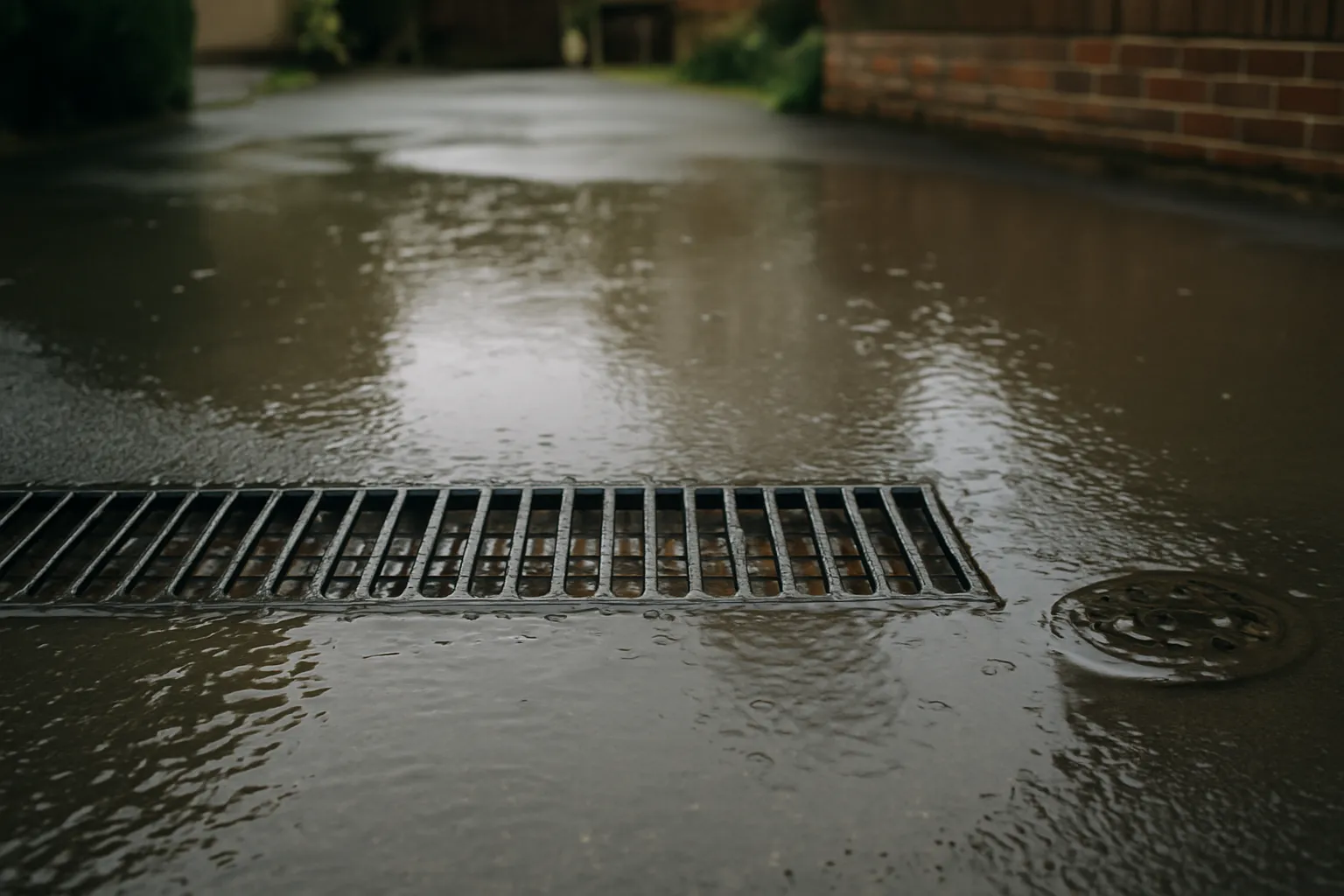
Blocked Driveway Drain After Heavy Rain: Gully, Channel or Underground Run?
Heavy rain hits, your driveway turns into a paddling pool, and you are standing at the window wondering whether you have a blocked drain or just live in Staines. Both are entirely possible. The good news is that a bit of detective work will tell you which one you are dealing with, and most of the diagnosis requires nothing more than a torch and a willingness to crouch near some standing water.
First, a Genuinely Useful Distinction
Driveway drainage comes in three flavours, and each fails in its own charming way.
A surface channel drain (the long, narrow grate running across your drive) collects water as it flows across the surface. It blocks at the grate or just below it, usually with leaves, grit and what professionals in the industry call “general grimness.”
A gully trap (a single round or square grate, often at a low corner of the drive) sits above a small pot of water, which acts as a seal against drain smells. That pot fills up with silt over time and eventually has nowhere left to put the rain.
An underground run is the pipe that carries water away from either of the above. When this is the problem, the channel and gully may look perfectly clear, but water backs up anyway because there is nowhere for it to go.
Step One: Look Before You Assume
Before you call anyone, take a few photographs. Get a shot of the standing water level, the grate or gully, and, if you can safely lift the grate, what is visible underneath. These images are genuinely useful to a drainage engineer when they arrive, and they give you a timestamp if you later need to speak to your insurer.
Check the grate itself first. If it is buried under autumn leaves, moss or compacted grit, you have found your culprit. Clear it carefully by hand (gloves on), and see whether the water begins to move within ten minutes or so.
If the grate is clear, peer into the gully pot. If it is brimming with black silt right to the top, that is a blocked gully trap. A professional will jet it clear, typically for somewhere in the range of £80 to £150 depending on access and depth.
If the grate is clear and the gully looks fine but water is still not moving, the blockage is likely further down the underground run. That needs a drain jetting machine and, if the problem keeps returning, a CCTV survey (a camera sent down the pipe on a flexible rod, so we can see exactly what is going on inside) to rule out root ingress (tree roots that have grown into and partially or fully blocked the pipe), a collapsed section, or a silted-up soakaway (a rubble-filled pit that absorbs water into the ground, which stops working when the surrounding soil becomes saturated).
What Not to Do
Do not pour anything down a flooded drain to try to shift it. Bleach, boiling water and chemical drain cleaners do nothing useful to a drain full of silt or roots, and they can damage older clay pipes. They also end up in the surface water system, which connects directly to local watercourses without treatment.
Do not use a pressure washer to blast debris into the gully. You will compact the problem further down the pipe.
When Should the Water Go Down on Its Own?
If you live in a low-lying part of Staines, Ashford or along the Thames flood plain, some surface pooling after sustained heavy rain is completely normal. The ground is saturated, the drains are running at capacity, and the water has simply nowhere to go yet. In these cases, a drive that drains slowly but does eventually clear within an hour or two of the rain stopping is probably working as intended, just working hard.
Persistent flooding that lasts several hours after rain stops, water that backs up rather than simply pooling, or flooding that is getting worse each time it rains, all of those suggest a blockage or a structural issue worth investigating.
When to Call for Help
Get in touch with a drainage professional when:
- Water is not clearing two or more hours after rain has stopped
- The same spot floods every time it rains, and it is getting worse
- You can smell drains when the water is standing (which suggests the underground run is involved)
- Lifting the gully grate reveals water that is actively rising, not just sitting still
- The flooding is reaching your threshold or garage floor
A CCTV survey of an underground run typically costs between £150 and £300 for a residential driveway drain, and it will tell you definitively what is happening inside the pipe. Jetting alone costs less, but if the blockage keeps returning, the survey saves money in the long run by identifying the root cause rather than treating the symptom.
One Thing to Rule Out
If your neighbours are also flooded and the road itself is underwater, the problem may be with the public surface water sewer rather than your private drain. In that case, the responsibility lies with Thames Water, and it is worth reporting to them directly as well as managing your own drainage.
If your driveway is flooded right now and the water is not moving, Drainiacs covers Staines, Ashford and the wider TW postcode area around the clock. Call 07700 137648 and we will tell you honestly what you are dealing with and what it is likely to cost before we start any work.