Emergencies
Drain Blockage After a Storm: What the First Overflow Point Means
Where water first appears after a storm tells you exactly which drain has failed and who owns it. Here's how to read the signs in TW.
Published 4 August 2026
The Storm Has Passed. So Why Is Water Still Rising?
A heavy downpour hits Twickenham, Richmond or Staines, and suddenly there is water where water should not be. The instinct is to panic first and investigate later. Understandable. But here is the thing: the exact spot where water first appears is your drain system sending you a very precise diagnostic message, and reading it correctly saves time, money, and a lot of unnecessary guesswork.
This guide walks you through the four most common first-overflow points, what each one means, and who is likely responsible for sorting it. Keep your phone handy to photograph everything. That evidence matters more than you think.
Why “First Overflow Point” Is the Key Phrase
A drain network is a chain. When one link fails, water backs up until it finds the weakest exit. That exit, the first place water breaks out, tells you where the blockage or failure sits. Everything downstream of that point is fine. Everything upstream is where your problem lives.
The Four First-Overflow Points
1. Water Backing Up From a Roof Downpipe or Overflowing Gutters
What you see: Water pouring over the top of a gutter, or bubbling out at the base of a downpipe rather than draining away.
What it means: The downpipe itself, or the underground connection between the downpipe and the surface-water drain, is blocked. Leaf litter, moss and storm debris are the usual culprits. This is almost always within your private curtilage, meaning it is your responsibility.
What to photograph: The overflowing gutter, the base of the downpipe, and any pooling water around it. A photo showing the downpipe outlet at ground level is especially useful.
Likely fix: Jetting or rodding the underground connection, plus clearing the downpipe. Indicative cost for a straightforward clearance: £80 to £200 depending on access and depth.
2. A Surface Gully Backing Up or Overflowing
What you see: The metal or plastic grid set into a yard, driveway or patio is sitting under standing water, or water is actively welling up around it rather than draining down.
What it means: The gully pot (the small chamber below the grid that catches debris before it enters the pipe) is either full of silt and leaves, or the pipe leading away from it is blocked. Gullies block fast in storms because they collect everything that washes off hard surfaces.
What to photograph: The standing water around the gully, the gully grid itself, and any debris visible through the grid. If water is coming back up rather than draining, photograph that specifically.
Likely fix: Lifting the grid, clearing the pot, and jetting the outlet pipe. Indicative cost: £90 to £250. If the gully is on your property, it is yours to fix.
3. An Inspection Chamber Lid Lifting or Surcharging
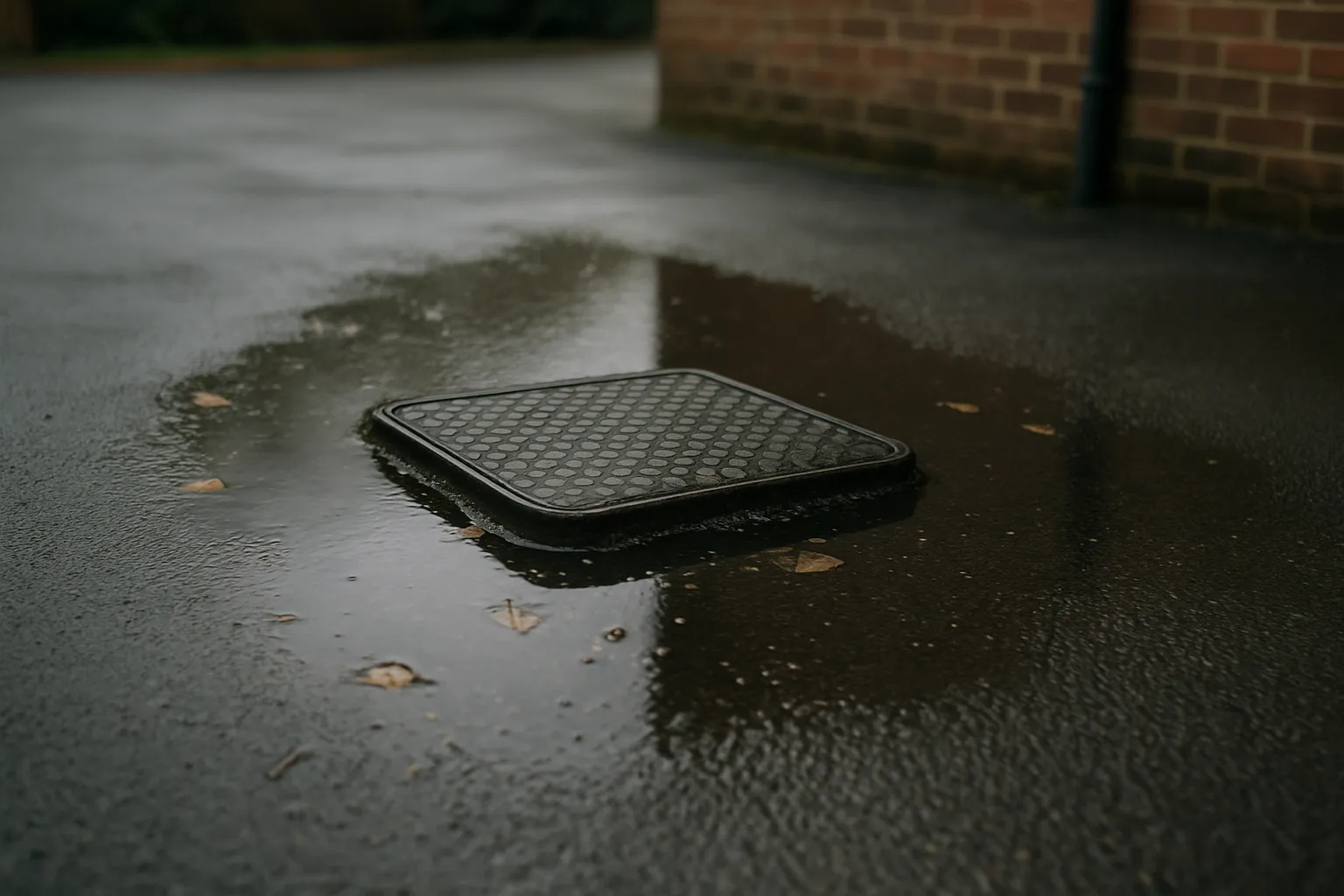
What you see: One of those square or circular covers in your garden or driveway is sitting proud of the ground, has water seeping around its edges, or has actually lifted. This is called surcharging. It means the chamber below is full and under pressure.
What it means: The blockage is downstream of that chamber, somewhere in the pipe running away from it. The chamber is simply the first exit point the backed-up water found. This is the most diagnostically useful overflow point because it tells you the blockage is between this chamber and the next one in the chain.
What to photograph: The lifted or wet lid, any water around it, and its location relative to your house. If you can safely lift the lid yourself (do not force it), photograph the water level inside. Do not reach in.
Likely fix: CCTV survey (a small camera sent through the pipe, like a very unglamorous nature documentary) to locate the blockage, then jetting to clear it. Indicative cost for survey and clearance: £150 to £400. Responsibility depends on whether the chamber serves only your property or connects to shared or public drains.
4. Water Appearing at the Road Gully or Pavement Edge
What you see: The drain set into the kerb or pavement outside your property is overflowing, or water is running along the road rather than draining.
What it means: The public surface-water sewer or highway drain is overwhelmed or blocked. This is almost certainly Thames Water or your local council’s responsibility, not yours.
What to photograph: The road gully, the direction water is flowing, and any visible flooding on the highway. Report to Thames Water (for sewers) or the London Borough or Surrey County Council (for highway drains). Your photos support that report.
Your action: Report it, then call us if water from the road is backing into your property through a private connection. That junction point may be your responsibility even if the public drain beyond it is not.
A Quick Visual Checklist Before You Call
- Where did water first appear? Roof level, ground level, below ground, or on the road?
- Is the overflow point on your property or on the public highway?
- Does the overflow point serve only your property, or do neighbours share it?
- Have you photographed the first overflow point, the water level, and the surrounding area?
Those four answers will make any conversation with us, Thames Water, or your insurer significantly faster and more productive.
Health and Safety Note
Raw sewage backing up through an inspection chamber or internal drain is a health hazard. Keep children and pets away from any overflow point that may contain foul water. Do not attempt to clear a surcharging chamber by hand. Wash hands thoroughly after any contact with drain water or surrounding soil.
What Happens Next
If you are in the TW postcode area and water is still rising, or you cannot identify which point is failing, call us now. We carry CCTV equipment on every van, we are available around the clock, and we aim to reach most TW locations within the hour. Knowing your first overflow point before you call will help us bring the right kit first time.
Call Drainiacs on 07700 137648, any time, any weather.