How-to
Washing Machine Drain Backing Up? The Standpipe Clues That Matter
Diagnose a washing machine drain backing up in TW homes. Spot whether it's a local standpipe issue or a deeper blockage, and know when to call a drainage engineer.
Published 24 July 2026
Why Your Washing Machine Drain Is a Surprisingly Honest Informant
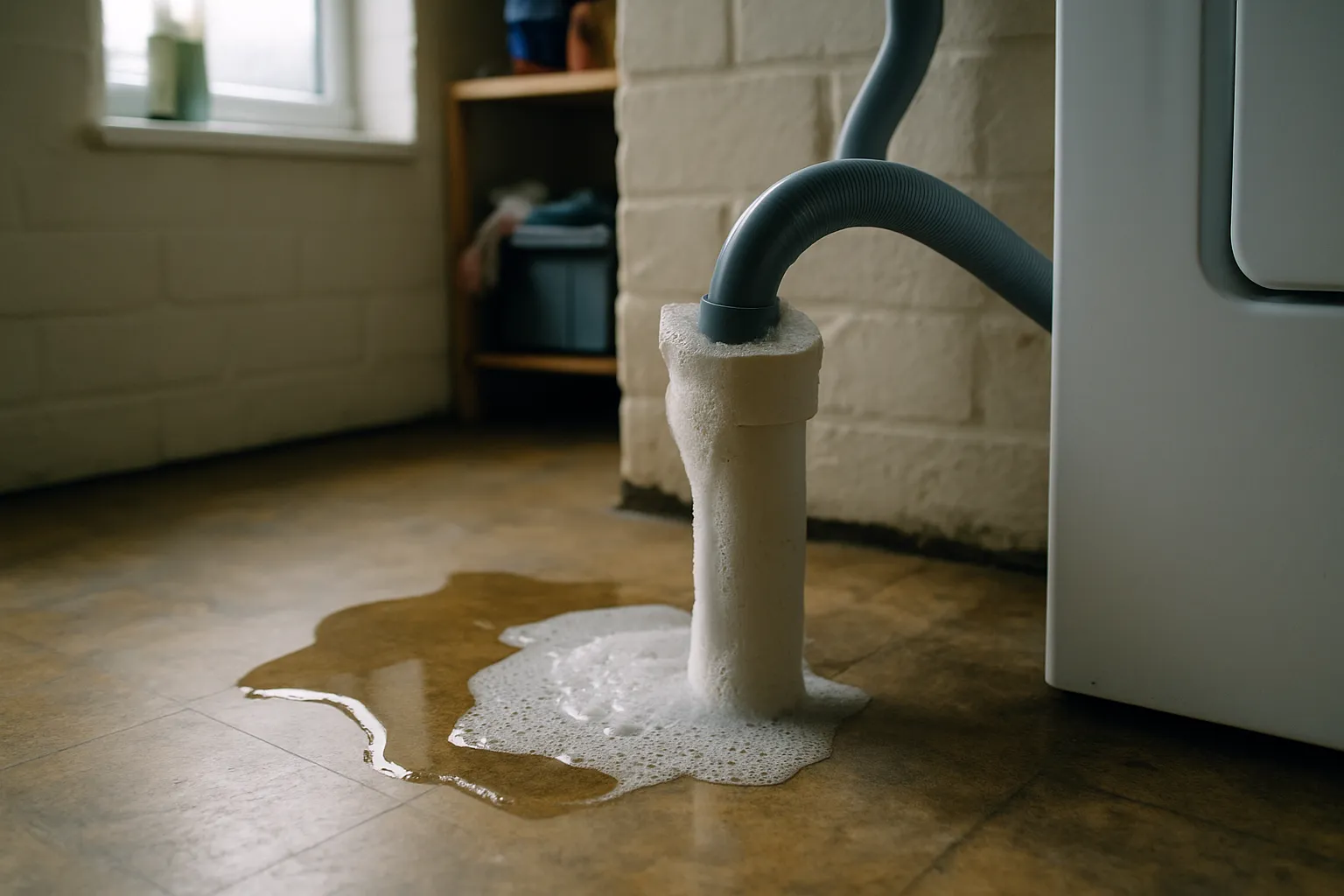
A dripping tap hides a lot. A washing machine does not. When your machine finishes its spin cycle and fires eight to twelve litres of water down the waste pipe in about ninety seconds, it creates a pressure surge that exposes every partial restriction lurking in your drainage system. If that water has nowhere to go, it comes straight back up the standpipe and onto your floor. Annoying? Yes. Useless information? Absolutely not.
The good news is that the location and timing of the overflow tells you quite a lot about where the problem actually lives.
Two Very Different Faults, One Similar Symptom
The Standpipe and Trap (Local Issue)
The standpipe is the vertical pipe your washing machine’s drain hose hooks into, usually 40 mm or 50 mm in diameter. At its base sits a trap, which is a small U-shaped section that holds water to block sewer gases. Both can block independently of anything further downstream.
Common causes here include accumulated lint, soap scum that has set solid, and the occasional forgotten tissue that made it through a pocket check. If water backs up immediately, right at the standpipe, and drains away slowly over the next few minutes, this local trap is the most likely suspect. A drainage engineer can clear this quickly, usually within the same visit, and costs for a straightforward standpipe and trap clear typically fall in the range of £80 to £150 depending on access and severity.
The Branch Line or Shared Waste (Downstream Issue)
If water backs up at the standpipe but also appears elsewhere, such as a nearby sink gurgling, a toilet bubbling, or water rising in a bath, the restriction is further along the branch line. The branch line is the pipe that carries waste from several appliances to the main soil stack or drain outside. A washing machine pump is powerful enough to expose a partial blockage in this shared pipe that a tap running at normal pressure simply would not disturb.
This is a more involved job. A drainage engineer will typically use a high-pressure water jetter (a machine that blasts water through the pipe at controlled pressure to break up and flush blockages) or recommend a CCTV survey (a small camera sent through the pipe on a cable, so the engineer can see exactly what is causing the restriction and where). CCTV surveys in TW postcodes typically run from £120 to £250 for a standard residential line.
A Note on Older Properties in the TW Area
Converted flats and Victorian terraces are common across Twickenham, Richmond, Hounslow and the surrounding TW postcodes. Their drainage layouts vary enormously because they have often been modified multiple times over decades. A washing machine in a converted ground-floor flat may share a branch line with two floors of appliances above it, or it may discharge into a gully outside that nobody has touched since the 1970s. The point is: do not assume your layout matches your neighbour’s. If a drainage engineer needs to trace the run before jetting, that is not inefficiency, it is just the reality of older property drainage.
Safe Checks You Can Do Yourself
Before calling anyone, run through these quickly.
- Check the drain hose is not kinked or pushed too far into the standpipe. The hose should sit loosely in the standpipe, not be rammed down and sealed. A hose sealed into the standpipe can cause siphoning and mimic a blockage.
- Check the standpipe opening for visible lint or debris at the top. If you can see a solid mat of fluff, remove it carefully with gloved hands.
- Run a small amount of hot (not boiling) water down the standpipe from a jug. If it drains away freely, the trap is clear and the issue may be the hose position or the machine’s own filter.
- Check your machine’s pump filter. Most front-loaders have a small access panel at the bottom front. A clogged pump filter reduces discharge pressure and can cause slow drainage that looks like a pipe blockage.
What Not to Pour Down a Washing Machine Waste
Drain unblockers sold in supermarkets are formulated for sinks and are often caustic. Pouring them into a standpipe connected to a machine with rubber seals and plastic components can cause damage that costs far more than the blockage itself. Do not use chemical drain cleaners in a washing machine waste system. Hot water and, if the trap is accessible, a plunger are the safe limits of DIY here.
When to Stop Diagnosing and Call a Drainage Engineer
Call a professional if any of these apply.
- Water is backing up into more than one fixture at the same time.
- The standpipe overflows on every cycle, not just occasionally.
- You can smell sewage rather than just soapy water.
- The property is a converted flat and you are unsure where your waste line runs.
- The problem has returned within a few weeks of a previous clear.
A recurring blockage in the same location usually means there is an underlying cause, such as root ingress (tree roots growing into the pipe joints), a collapsed section, or a build-up of grease and lint at a pipe junction that needs proper jetting rather than a temporary poke-through.
Get It Sorted
A washing machine drain backing up is one of those faults that rewards quick action. Left alone, repeated overflow soaks subfloor timbers, encourages mould, and the blockage itself tends to worsen rather than resolve on its own.
If you are in the TW postcode area and the checks above have not resolved the issue, or if you are seeing signs of a shared-line blockage, call Drainiacs on 07700 137648. Engineers are available around the clock, and a real person will answer, not a voicemail.
If the water is coming from the machine’s hose or inlet valve rather than the drain, that is a plumbing leak. Our sister plumbing firm Emergency Plumbers TW cover washing machine and dishwasher leaks.