Commercial
Commercial CCTV Drain Surveys: What Your Insurer and Your EHO Both Want to See
What a commercial CCTV drain survey report must contain to satisfy your insurer and Environmental Health Officer, with honest cost ranges.
Published 11 July 2026
The Report Is the Product
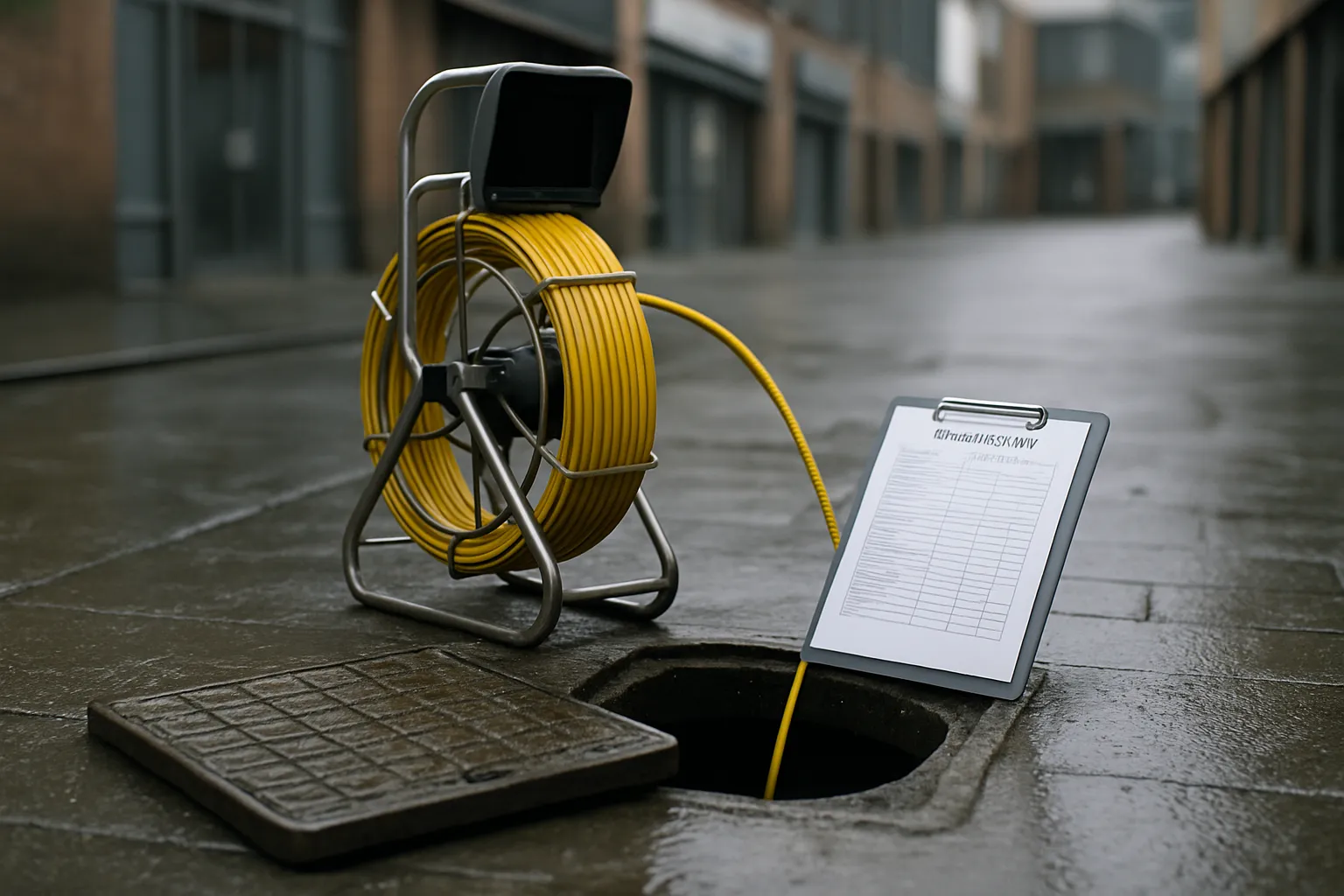
A CCTV drain survey is not just a bloke with a camera confirming your pipes are not full of ancient sandwich. The footage is evidence. The written report is a compliance document. If your insurer or your Environmental Health Officer (EHO) asks to see it, they are not interested in the video alone. They want a structured, dated, referenced report they can file and, if necessary, cite in a formal proceeding.
This guide explains exactly what that report needs to contain, how often you should be commissioning one, and what the financial stakes look like either way.
Why Commercial Premises Face Extra Scrutiny
Residential drains are a private matter until they back up into the street. Commercial drains are a different story. Food businesses, care homes, schools, hotels, gyms, and any premises with a grease trap or interceptor (a sealed chamber that separates fats and oils from the main drain run) operate under obligations that can involve:
- The local authority’s Environmental Health team
- Your commercial property insurer
- Your lease terms, if a landlord requires periodic surveys
- The Water Industry Act 1991, which governs what enters the public sewer
An EHO can request evidence of drain maintenance as part of a routine inspection. An insurer can decline a claim for drainage-related damage if you cannot demonstrate adequate maintenance. Neither of these is a theoretical risk. Both happen.
What the Report Must Contain
A compliant CCTV drain survey report for commercial use should include the following sections. If a surveyor hands you anything less, ask for a revised document before you sign off.
Site identification. Full address, date of survey, surveyor name and company, and the specific drain runs inspected. Vague references to “the drains” are not adequate.
Pre-survey condition notes. Any access difficulties, manholes that could not be opened, or sections that could not be surveyed, with reasons. Gaps in coverage must be declared, not quietly omitted.
Camera log with WRC codes. The Water Research Centre (WRC) coding system is the industry-standard way of describing defects found during a CCTV survey. Each defect gets a code, a location reference measured from the nearest manhole, and a severity grade. Your insurer and your EHO both recognise this system. A report without it is not a professional drainage survey; it is a description.
Photographic and video evidence. Timestamped stills at each defect point, plus the full survey footage on a format you can actually open. Both are required.
Drainage plan or schematic. A diagram showing the drain runs surveyed, manhole positions, flow directions, and where each defect sits within the system.
Recommendations, graded by urgency. Defects are typically graded as immediate action required, maintenance recommended within a set period, or monitor at next survey. This grading tells you, your insurer, and the EHO what the surveyor believes the risk level to be.
Surveyor sign-off. Name, qualification, and company registration. An unsigned report is worth nothing in a formal context.
How Often Should a Commercial Premises Be Surveyed?
There is no single statutory interval that applies to every business, but the following benchmarks are widely used and generally accepted by insurers and local authorities.
Food businesses with high grease output: every 12 months, sometimes every six months if the grease trap is large or the volume of covers is high.
General commercial premises (offices, retail, light industrial): every two to three years, or at each change of tenancy.
Premises with a history of blockages or root ingress (root ingress means tree roots have grown into the pipe, typically through a joint or a crack): annually until the cause is resolved.
If you are purchasing a commercial property, a drainage survey before exchange is strongly advisable. A defect found post-completion is your liability. A defect found pre-exchange is a negotiating point.
What Does a Commercial CCTV Survey Cost?
Indicative ranges only, as every site is different.
A standard commercial survey covering a single drain run with a written report: roughly £250 to £450.
A full site survey covering multiple runs, several manholes, and a complete drainage schematic: typically £500 to £1,200 depending on site complexity and access.
Remedial work, if defects are found, is quoted separately. Common follow-on work includes high-pressure water jetting (clearing blockages and built-up grease using pressurised water), patch lining (repairing a localised crack or joint without digging), or full pipe relining (inserting a new pipe lining inside the existing one, avoiding excavation). Each of these carries its own cost range, and a reputable surveyor will provide a written quote before any work begins.
The cost of not having a survey when an insurer or EHO asks for one is harder to quantify, but a declined insurance claim on a commercial property can run to tens of thousands of pounds. The survey is not an overhead. It is a documented defence.
What Happens After the Survey
If the report is clean, file it. Keep the digital footage alongside it. When your insurer or EHO asks, you hand it over. That is the entire process.
If the report identifies defects, you will receive graded recommendations. Immediate-action items should be treated as exactly that. Scheduled maintenance items should go into your property maintenance calendar with a realistic deadline.
A follow-up survey after remedial work is standard practice and produces a second report confirming the defect has been resolved. This is the document that closes the loop for compliance purposes.
Covering the TW Area
Drainiacs carries out commercial CCTV drain surveys across the TW postcode area, including Staines, Shepperton, Sunbury, Ashford, Feltham, Hounslow, Richmond, Twickenham, and surrounding areas. Surveys are available seven days a week, and reports are produced in a format suitable for submission to insurers and local authority Environmental Health teams.
If you need a commercial drain survey booked, or if you have an active drainage issue at a business premises, call 07700 137648. We will tell you what the survey involves, what the report will contain, and what the timeline looks like before any work begins.
For the water damage side of a commercial claim, our sister plumbing firm Emergency Plumbers TW handle escape of water repairs and insurance documentation.