How-to
Whose Drain Is It? Thames Water vs You, TW Edition
Who is responsible for a blocked drain in the TW area? We break down Thames Water, your council and your own liability, street by street.
Published 16 July 2026
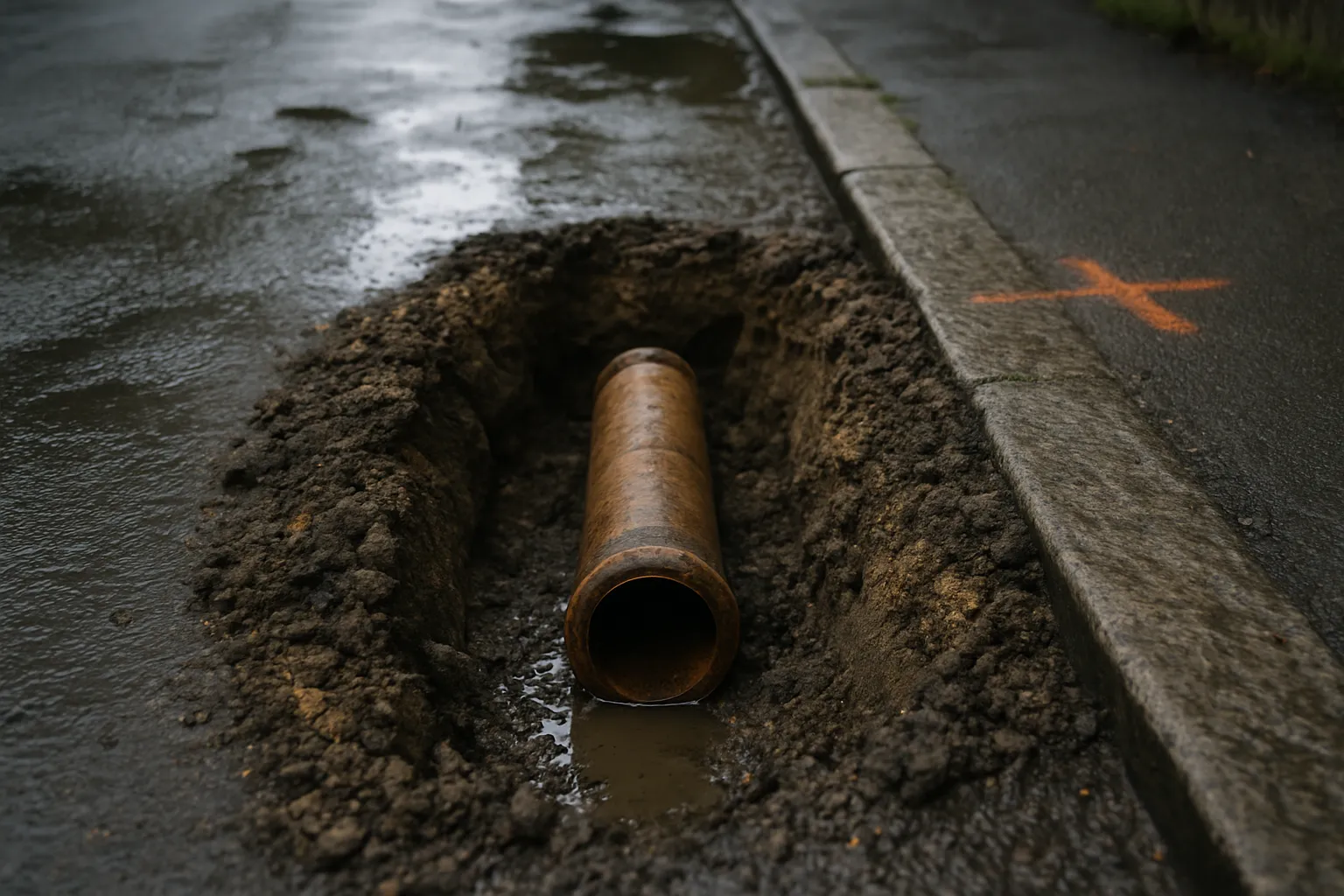
Whose Drain Is It? Thames Water vs You, TW Edition
Here is the question every TW resident eventually Googles, usually at 11 pm with water backing up through the kitchen sink: is this my problem, or someone else’s? The honest answer is: it depends on exactly where the blockage is sitting. This page tells you how to work that out, who to call for each scenario, and what they will actually do about it.
The Basic Split: Your Drain, the Lateral Drain, the Public Sewer
Think of your drainage in three sections.
Your private drain runs from your property to your boundary. Fully your responsibility. If it blocks, you pay to fix it. No argument, no grey area.
The lateral drain (the section of pipe that carries waste from your boundary to the public sewer, usually running under the pavement or road) became Thames Water’s responsibility in October 2011 under the Flood and Water Management Act. Before that date, shared private drains were a legal nightmare of split ownership. Now, if the blockage is in a shared pipe beyond your boundary, Thames Water own the problem.
The public sewer is Thames Water’s infrastructure entirely. They maintain it, they clear it, they pay for it.
The practical difficulty is that you cannot always tell from ground level which section is blocked. That is what a CCTV drain survey is for: a camera is fed through the pipe and the footage shows exactly where the obstruction is and which side of the boundary it sits on. Surveys in the TW area typically run from around £90 to £250 depending on access and pipe length.
What Thames Water Will and Will Not Come Out For
Thames Water operate a 24-hour reporting line and will respond to confirmed public sewer blockages. They will not attend for:
- A blockage inside your private drain (even if it is causing sewage to back up into your property)
- A suspected blockage where you have not already established the problem is in their pipe
- Anything on a private estate or development where the sewers were never adopted
The phone-tree reality: you report online or call 0800 316 9800, they log it, they assess priority, and they attend when they attend. For a road-level sewer surcharging (overflowing onto the street), they will treat it as urgent. For a slow drain you think might be their pipe, you may wait considerably longer.
In the meantime, sewage backing up into your home is a health hazard regardless of whose pipe caused it. That is not the moment to wait for Thames Water’s queue.
Your Council: Highway Gullies and Road Flooding
Thames Water own the sewers. Your council owns the highway drainage, meaning the gullies (the metal grilles in the kerb that take surface water off the road) and the pipes that run from them.
In the TW postcodes, the relevant councils are:
Richmond upon Thames Council covers Twickenham, Teddington, Hampton, Whitton and Isleworth. Report blocked highway gullies via the Richmond council website or their street care team.
London Borough of Hounslow covers Hounslow, Feltham, Brentford and Isleworth. Blocked road gullies go to Hounslow’s highways reporting portal.
Spelthorne Borough Council covers Staines, Ashford, Shepperton and Sunbury. Spelthorne handles its own highway drainage reporting, separate from the London boroughs above.
None of these councils are responsible for the drains inside your property. They will not attend for a blocked toilet or a backed-up kitchen sink. Their remit is the road surface and the gullies that drain it.
The Edge Cases the Generic Pages Skip
Shared drains on older terraces. Many Victorian and Edwardian terraces in Twickenham, Brentford and Isleworth were built with a single shared drain running under the rear gardens of an entire row. Post-2011, if that shared pipe runs beyond any one property boundary, Thames Water own it. But proving it is shared and getting Thames Water to agree can take time. A CCTV survey with a written report is your evidence.
Private roads and unadopted sewers. Parts of the TW area, particularly some riverside developments in Shepperton, Hampton and Staines, sit on private roads. If the road was never adopted by the council and the sewer was never adopted by Thames Water, both remain private infrastructure. The residents or a management company own them. There is no Thames Water bailout here.
Soakaways. A soakaway is a pit filled with rubble or a plastic crate buried in the ground, designed to let surface water drain slowly into the soil rather than into the sewer. They are common in parts of Sunbury and Ashford where the ground allows it. A failing soakaway is entirely the homeowner’s responsibility. Thames Water have no involvement.
Interceptor traps. Older properties sometimes have an interceptor trap (a water-sealed chamber designed to stop sewer gases entering the drain) near the boundary. These are notorious for silting up and blocking. They are on your side of the boundary. Your cost.
What to Do Right Now
- If sewage is backing up inside your home, stop using water-based appliances immediately.
- If the problem is clearly in the public road (a manhole surcharging, a gully overflowing), report it to Thames Water and your relevant council, then step back.
- If you are not sure which pipe is blocked, a CCTV survey gives you a definitive answer before you spend money on clearance in the wrong place.
- If the blockage is on your side of the boundary, or you need it cleared tonight regardless of who owns the pipe, that is what we are here for.
Drainiacs cover the full TW postcode area, 24 hours a day. If you have an active blockage or sewage backup and you need someone out tonight, call us on 07700 137648.