How-to
Tree Roots vs Clay Pipes: The Slow-Motion Wrestling Match Under Your Garden
Root ingress in clay drains explained: what it is, why it keeps coming back, and when relining beats repeated jetting. Covering Teddington and the TW area.
Published 6 July 2026
The Bout Nobody Asked For
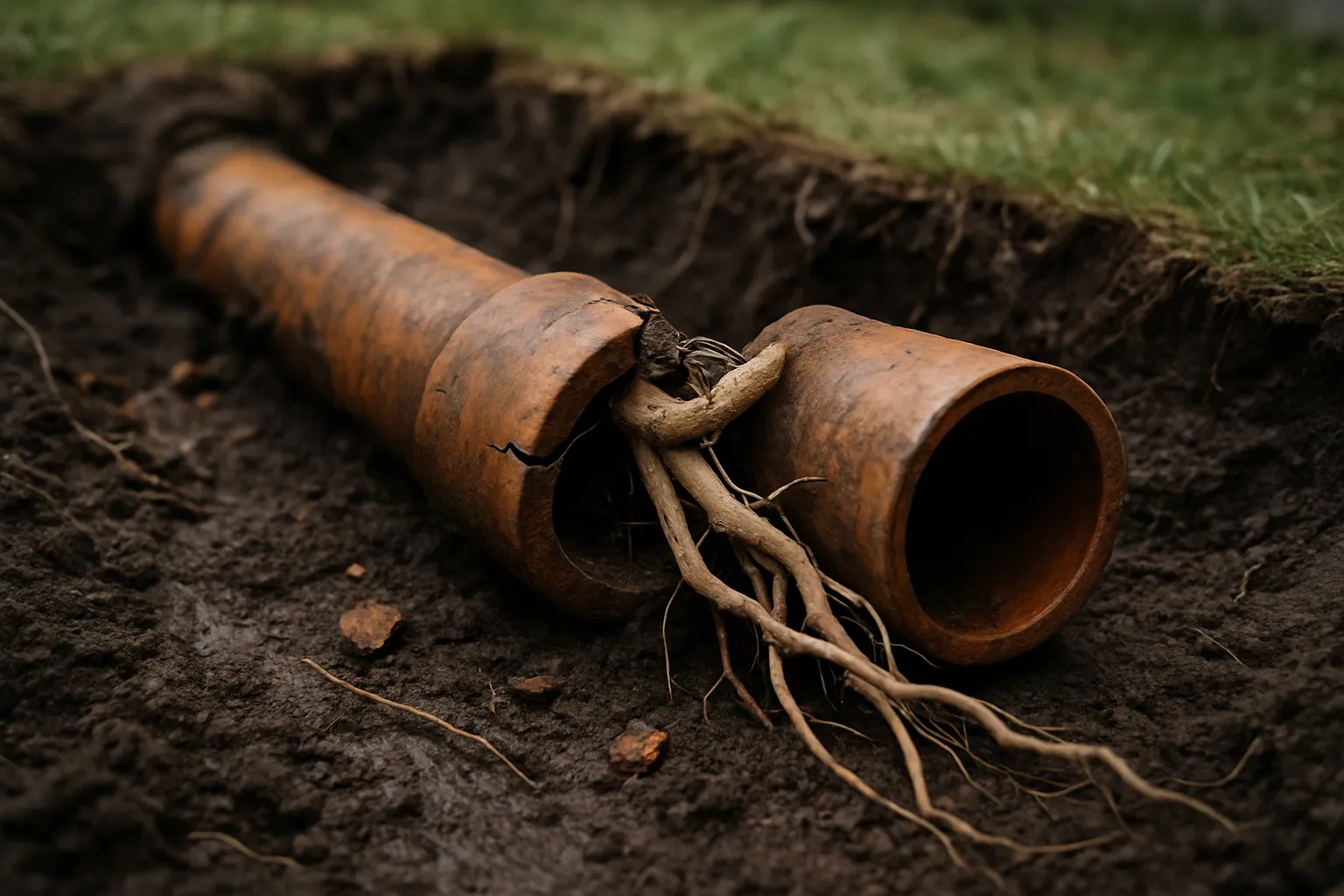
Somewhere under your garden right now, a willow root the width of a pencil is pressing its face against a clay pipe joint and whispering, “I will be in there by spring.” It is not malicious. It is not personal. It is just very, very patient.
Root ingress, which means roots growing in through the gaps between pipe sections rather than through solid pipe walls, is one of the most common reasons drains in Teddington and the wider TW area slow down, block, and then block again six months later despite being cleared. Clay pipes were the standard installation right up into the 1970s, and the joints between sections are essentially a standing invitation for any root that senses warm, wet, nutrient-rich air drifting out. Which, to a root, is roughly equivalent to a Michelin-star restaurant with the door left open.
Round One: The Root Wins (Quietly)
The first sign is usually a drain that runs slowly but clears with jetting. Jetting means blasting water at high pressure through the pipe to shift blockages. You feel briefly victorious. The drain behaves for a few months. Then it slows again.
What the camera shows, when we send one down, is a hairy fringe of fibrous roots growing inward from the joints, catching passing debris like a very enthusiastic net. Left long enough, those fibres thicken into woody intrusions that can crack the pipe itself, not just block it.
A CCTV drain survey, which means running a small camera through the pipe on a flexible rod so we can see exactly what is happening and where, is usually the only way to confirm root ingress rather than a straightforward grease blockage. The two look identical from the surface.
What the Camera Finds (Narrated With Appropriate Reverence)
Picture the footage. The pipe interior scrolls past, slightly oval from decades of ground movement, the old glazed clay catching the camera light. Then, at joint number three, a tendril. Then another. By joint seven, it is a small forest. Somewhere off-camera, a tree is utterly unbothered by all of this.
Common culprits in Teddington gardens are willow, poplar, silver birch, and, for reasons that feel almost vindictive, the ornamental cherry. Established trees within roughly three to five metres of a drain run are worth noting when we survey.
Round Two: Clearing vs. Fixing
Here is the straight bit, because this is where the decision actually matters.
Cutting alone means using a mechanical root cutter, a rotating blade on a rod, to remove the intrusion. It works. The drain flows freely. But the joint gap that let the root in is still there, the tree is still there, and the root will return. Typical timescale for regrowth: six months to two years depending on tree species and soil conditions. Cutting is the right call when the pipe is otherwise sound and the customer wants a lower upfront cost, with the understanding that it is a maintenance solution, not a permanent fix.
Relining means inserting a resin-impregnated sleeve into the existing pipe and inflating it against the pipe walls, where it cures into a new, seamless inner pipe. No joints. Nothing for a root to push through. The existing clay pipe becomes the mould and the reline becomes the drain. Indicative cost for a typical residential reline in the TW area: roughly £800 to £2,500 depending on diameter, length, and access, though a survey is always needed before any honest figure can be given.
Relining is not always possible: very badly collapsed pipes, or sections with significant offset joints, may need excavation instead. The camera tells us which situation you are in before any work starts.
Why Unblocking Alone Sets Up a Rematch
If a drain is cleared by jetting without a camera survey, and the cause was root ingress, you have not solved the problem. You have reset the clock. The roots are trimmed, the joint is open, the tree is still growing. In twelve months you are back to a slow drain, possibly with more structural damage than before, because the roots that regrew had a wider channel to follow.
A CCTV survey costs roughly £120 to £250 for a standard residential run. That figure sits inside the cost of two or three repeat call-outs for the same blocked drain. The survey also produces a recording, which is useful evidence if you ever need to discuss the issue with your insurer or a neighbour whose tree is the culprit.
The Practical Summary
- Slow drain that keeps coming back: suspect root ingress, especially in older properties with mature garden trees.
- Get a camera survey before committing to any repair method.
- Cutting is a maintenance option. Relining is a structural fix.
- Excavation is sometimes necessary but is confirmed by survey, not assumed.
- Trees within three to five metres of a drain run are worth flagging to the surveyor.
If your drain is backing up now, or you have raw sewage appearing at ground level, that is a situation requiring immediate attention. Raw sewage carries pathogens including E. coli and hepatitis A. Keep children and pets away from the affected area, do not use sinks or toilets that drain to the blocked run, and call us straight away.
For any drain emergency in Teddington or across the TW postcode area, call Drainiacs on 07700 137648. We are here around the clock, and we will bring a camera.