How-to
When a Blockage Keeps Returning After Clearance: Three Causes Rodding Cannot Fix
Drain keeps blocking after clearance? Here are three structural causes rodding cannot fix, and the right sequence to sort it for good.
Published 22 July 2026
The Drain That Just Will Not Stay Clear
You called someone out. They rodded it. Flow returned. Three weeks later, same drain, same smell, same standing water. You called again. They rodded it again. Flow returned. You are now on a first-name basis with the engineer and you are starting to suspect the drain is doing this on purpose.
It is not personal. But it is structural. Rodding (pushing a flexible rod through the pipe to break up a blockage) is a genuinely useful tool for clearing an obstruction that is already there. What it cannot do is change the conditions that keep creating the obstruction. If something inside or around the pipe is generating the same problem repeatedly, rodding will clear the symptom every time and leave the cause completely untouched.
Here are the three most common reasons a drain keeps blocking after clearance.
Cause 1: Grease or Scale Coating the Pipe Wall
Fats, oils and greases cool and solidify on pipe walls. Over months and years they build up into a rough, sticky coating. That coating catches everything else passing through, which builds the blockage faster each time.
High-pressure water jetting (a powerful flush of water at controlled pressure, sent down the pipe on a flexible hose) can strip that coating back to the pipe surface. Rodding cannot. It punches a hole through the soft centre of the blockage and restores flow, but leaves the coating behind. The next blockage forms in weeks rather than months because the rough surface is still there, still catching debris.
In Feltham’s newer estates, modern plastic pipework is actually more prone to grease adhesion than older glazed ceramic pipes, because the joins sit slightly proud and give grease a ledge to cling to. If your drain has blocked twice in less than six months and the pipe is relatively modern, a jetting session rather than another rod is usually the better call.
Cause 2: Root Ingress at a Damaged Joint
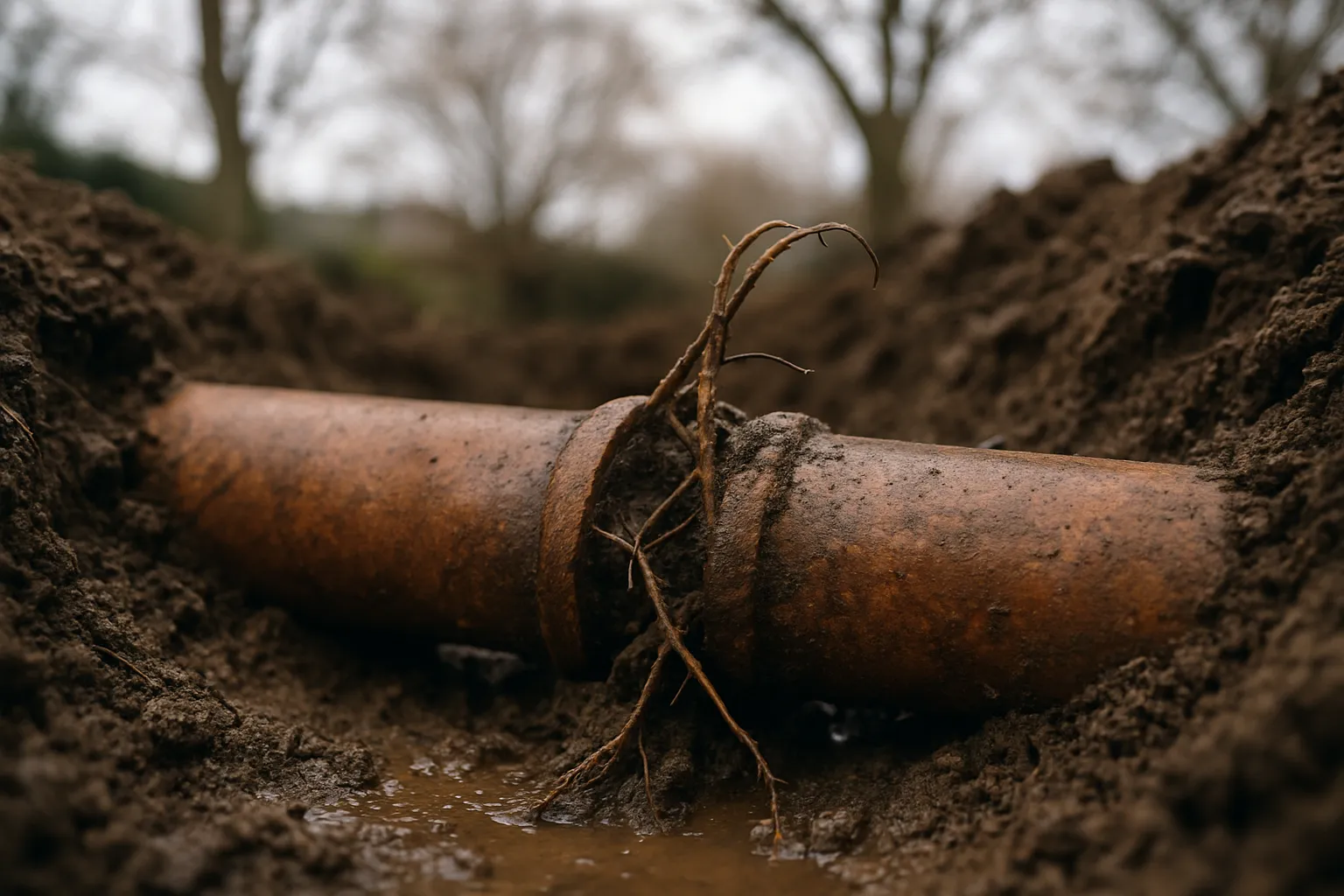
Root ingress means tree or shrub roots have found their way inside the pipe, usually through a cracked joint or a section where two pipe lengths have separated slightly over time. Roots do not break in dramatically. They find the moisture and nutrients leaking from a hairline crack and push through it, slowly, over years.
Once inside, roots form a fibrous mesh that catches wipes, paper and grease. Rod out the mesh, and the roots simply regrow. The crack or open joint that let them in is still there, still weeping, still inviting them back.
Feltham sits alongside stretches of the Crane valley and has a mix of mature street trees and established garden planting. Root ingress is a regular finding on CCTV surveys here, particularly in clay-jointed ceramic mains that were laid decades ago and have shifted slightly as the ground has moved.
The only permanent fix is to seal or repair the joint. Options include patch lining (a short sleeve bonded inside the pipe at the damaged point) or full pipe relining (a resin liner cured inside the existing pipe, effectively creating a new pipe within the old one, no excavation required in most cases). Neither of those can happen until a camera has confirmed exactly where the damage is.
Cause 3: A Broken or Badly-Falling Section
Pipes need a consistent fall (a gentle downward slope) to carry waste away by gravity. If a section has cracked, collapsed partially, or settled unevenly, waste slows, debris accumulates and you get a blockage. Rod it clear, and the low spot fills again within weeks.
A badly-falling section can also cause back-pooling, where water sits in the pipe between uses. That standing water is a breeding environment for the grease and scale described above, so the two causes compound each other.
Structural collapse or serious misalignment usually requires excavation and replacement of the affected length, though a CCTV survey (a small camera sent through the drain on a flexible cable, recording footage of the pipe interior) will confirm the extent before any decision is made.
The Right Sequence When a Blockage Keeps Returning
- Note the history. How many times has it blocked, and over what period? That pattern is useful diagnostic information.
- Book a CCTV survey. The camera records exactly what is happening inside the pipe: coating, roots, cracks, displacement, all of it. You get a report with footage.
- Choose the repair based on what the camera found. Jetting for coating, relining for root ingress or cracked joints, excavation for structural collapse. The survey tells you which, so you are not guessing.
Drainiacs carry CCTV equipment on every van covering the TW postcode area, including Feltham and the surrounding postcodes. If your drain has blocked more than once in the past year, a survey will cost less than another emergency call-out and will actually tell you what is going on.
If you have a drain backing up right now, call 07700 137648. We are available around the clock and will give you an honest assessment of whether you need a clear, a survey, or a repair.