Local
Teddington's Tree-Lined Streets: Beautiful Above Ground, Chaos Below
Teddington's avenue trees are gorgeous. Their roots are not. Find out which species wreck drains fastest and how a CCTV survey catches them early.
Published 13 July 2026
The View from Above Versus the View from Below
Walk down Broad Street or Teddington High Street on a summer morning and the canopy is genuinely lovely. Plane trees, limes, willows near the river, the odd silver birch doing its best. Estate agents have been writing the phrase “tree-lined streets” into Teddington listings since approximately forever.
What the estate agents do not mention is what those trees are doing at pipe level.
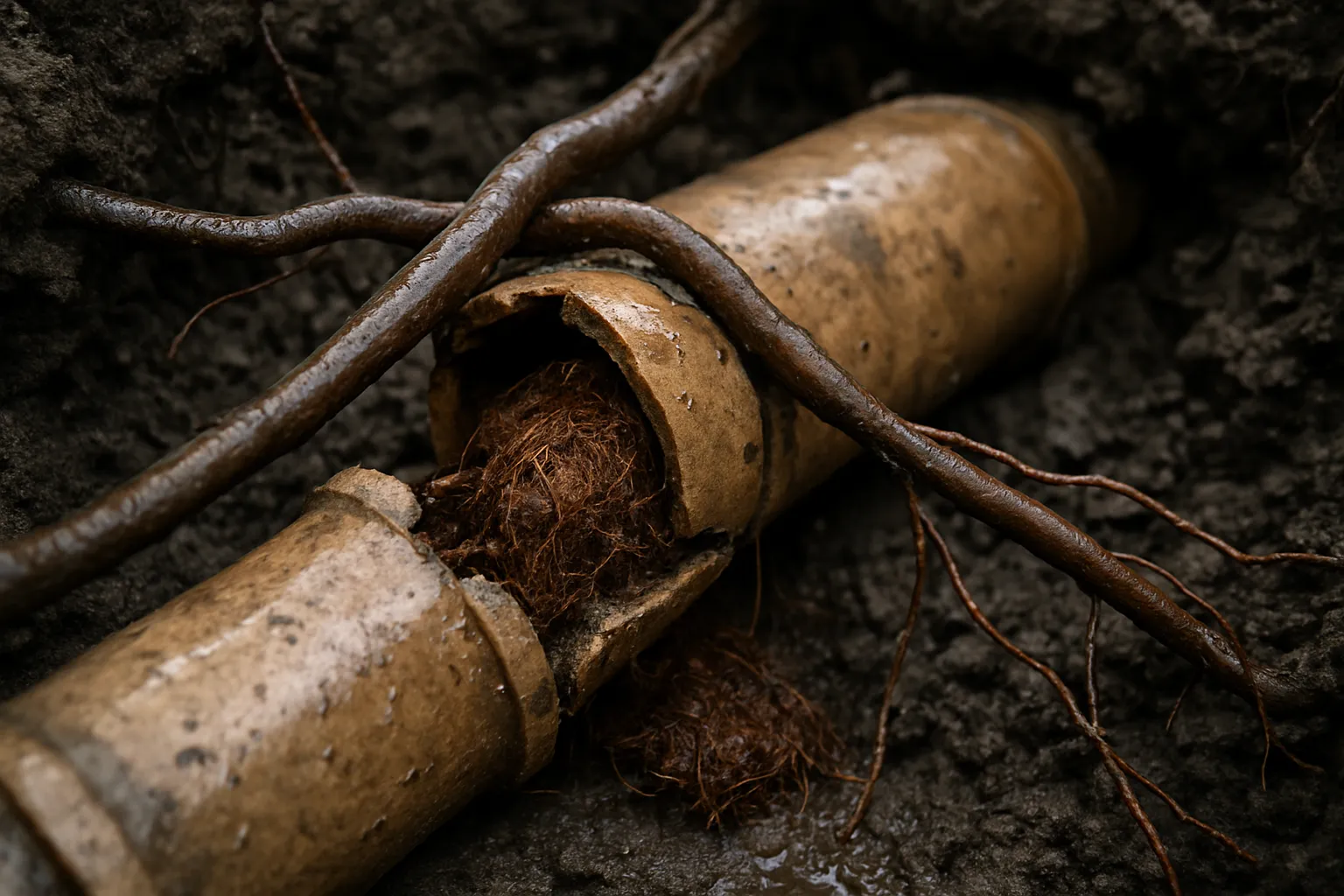
Beneath Teddington’s pleasant pavements sits a network of Victorian-era clay drainage pipes, many of them over a hundred years old. Clay pipes are laid in short sections with rubber or mortar joints between them. Those joints, over time, develop tiny gaps. To a tree root, a tiny gap in a warm, wet, nutrient-rich pipe is not a problem. It is an invitation.
The Worst Offenders in Teddington’s Streets
Not all trees treat your drains with equal disrespect. Here is the honest league table.
Willows are the undisputed champions. Any tree within roughly 30 metres of a pipe and within striking distance of the Thames or Beverley Brook should be considered a live threat. Willow roots can travel extraordinary distances seeking moisture and they are thin enough in early growth to squeeze through the smallest joint gap.
Lime trees (the council favourite for avenue planting, and everywhere in TW11) have aggressive surface root systems that can disturb pipe beds and crack older clay sections through ground movement alone, even before the roots get inside.
Plane trees are slightly better behaved underground than their reputation suggests, but their sheer size means root spread is enormous. Old specimens near Teddington Lock Road and along the riverside paths have root systems that have been quietly reorganising the local geology for decades.
Silver birch roots are less forceful but opportunistic. They find existing cracks rather than making new ones, which sounds polite until you realise the crack was already there.
What Root Ingress Actually Looks Like
Root ingress is the trade term for tree roots growing into your pipes. Think of it as uninvited house guests who also eat the walls.
In the early stages you will notice slow drainage. Water clears eventually, just not quickly. Most people assume a partial blockage and reach for the plunger. The plunger does nothing because the blockage is not a lump of something, it is a growing fibrous mass two metres down the pipe.
Left alone, the root mass catches passing debris, builds up into a full blockage, and eventually the pipe itself cracks or collapses around the intrusion. At that point you are looking at excavation rather than jetting, and the cost difference is significant.
Indicative costs to give you a rough sense: a CCTV drain survey (a camera inspection of your pipes, delivered on a screen in real time) in the Teddington area typically runs between £80 and £150 for a standard residential check. Drain jetting to clear a root mass, where the pipe is still structurally sound, is usually £100 to £250. Pipe relining (a no-dig repair where a resin sleeve is inserted and cured inside the existing pipe, effectively creating a new pipe within the old one) runs from around £500 upwards depending on length. Full excavation and pipe replacement is the expensive option and the one a timely survey is designed to help you avoid.
Why Teddington in Particular
Several factors combine here. The age of the housing stock means older clay pipes are the norm rather than the exception. The proximity to the Thames and its tributaries means the water table is relatively high and roots are actively searching for it. And the density of mature street trees, which nobody wants to remove because they are genuinely beautiful, means the root systems are extensive and well-established.
If you have bought a house in TW11 in the last few years, particularly anywhere near the river, Bushy Park, or the older residential streets around Queens Road and Park Road, a drain survey is not a paranoid luxury. It is a sensible check.
What a CCTV Survey Actually Shows You
A CCTV drain survey involves a small camera on a flexible rod being fed through your drainage system. You watch the footage in real time. The camera finds root intrusions, cracked joints, collapsed sections, displaced pipes, and any other structural problems. You get a written report and, usually, recorded footage.
It is, frankly, one of the more interesting things you can watch on a Sunday morning. The camera moves through the pipe like a submarine through a tunnel, and when it finds a root mass it is genuinely dramatic. Professionally speaking. The roots grow inward in fine threads, then thicker strands, then a full curtain of fibrous material blocking the flow. Nature is remarkable. It is also, in this context, your problem.
How Often Should You Check
For properties with large trees within 15 metres of drainage runs, a survey every three to five years is reasonable. If you have noticed slow drainage, gurgling sounds from toilets or sinks, or damp patches near external drain runs, do not wait for the next scheduled check.
If You Have a Problem Right Now
If your drain is blocked, backing up, or you can smell sewage, that is an emergency rather than a planning exercise. Drainiacs cover Teddington and the surrounding TW postcode area around the clock, every day of the year.
Call 07700 137648. We will give you an honest arrival time and a straight answer on what you are dealing with before any work begins.
If the damp patch turns out to be a leaking pipe rather than a drain, our sister plumbing firm Emergency Plumbers TW offer leak detection in Teddington.