Local
Hampton's Period Homes: A Drain Nerd's Tour of Edwardian Pipework
Edwardian drains in Hampton explained: interceptor traps, rest bends, shared runs and the CCTV survey that maps what's lurking beneath your period home.
Published 14 July 2026
Hampton’s Period Homes: A Drain Nerd’s Tour of Edwardian Pipework
Hampton is, frankly, a gift. Not just the river, the green, the handsome terraces on Percy Road and the Victorian villas tucked behind Hampton Hill. No. Hampton is a gift because beneath those elegant front gardens lies some of the most characterful, most stubbornly individual, most professionally fascinating drainage infrastructure in the whole TW postcode.
I realise that sentence might read as unhinged. It is. Let me explain.
Why Edwardian Drains Are Their Own Thing
When the Edwardians built Hampton’s streets between roughly 1900 and 1914, they were working to a drainage philosophy that was genuinely thoughtful for its era. They worried about sewer gas. They worried about rats. They built in safeguards that were, by the standards of the day, sophisticated. The problem is those safeguards are now over a century old, and they have developed opinions about retirement.
Here is what you are likely to have under your feet if you own a period property in Hampton, and what each feature tends to do in its old age.
The Interceptor Trap (Also Known as the Disconnecting Trap)
The interceptor trap is a sealed, water-filled chamber built at the point where your private drain meets the public sewer. Its job was to stop sewer gas and vermin travelling back up the private run. Clever idea. In 1908.
Today, an interceptor trap is the single most common cause of mystery blockages in Hampton period homes. The water seal dries out if the trap is unused for a while, the stopper corrodes, and the whole chamber silts up with decades of sediment. The result is a drain that backs up for no obvious reason, clears briefly, then backs up again. If your drain has a personality disorder, the interceptor trap is usually the one to interview first.
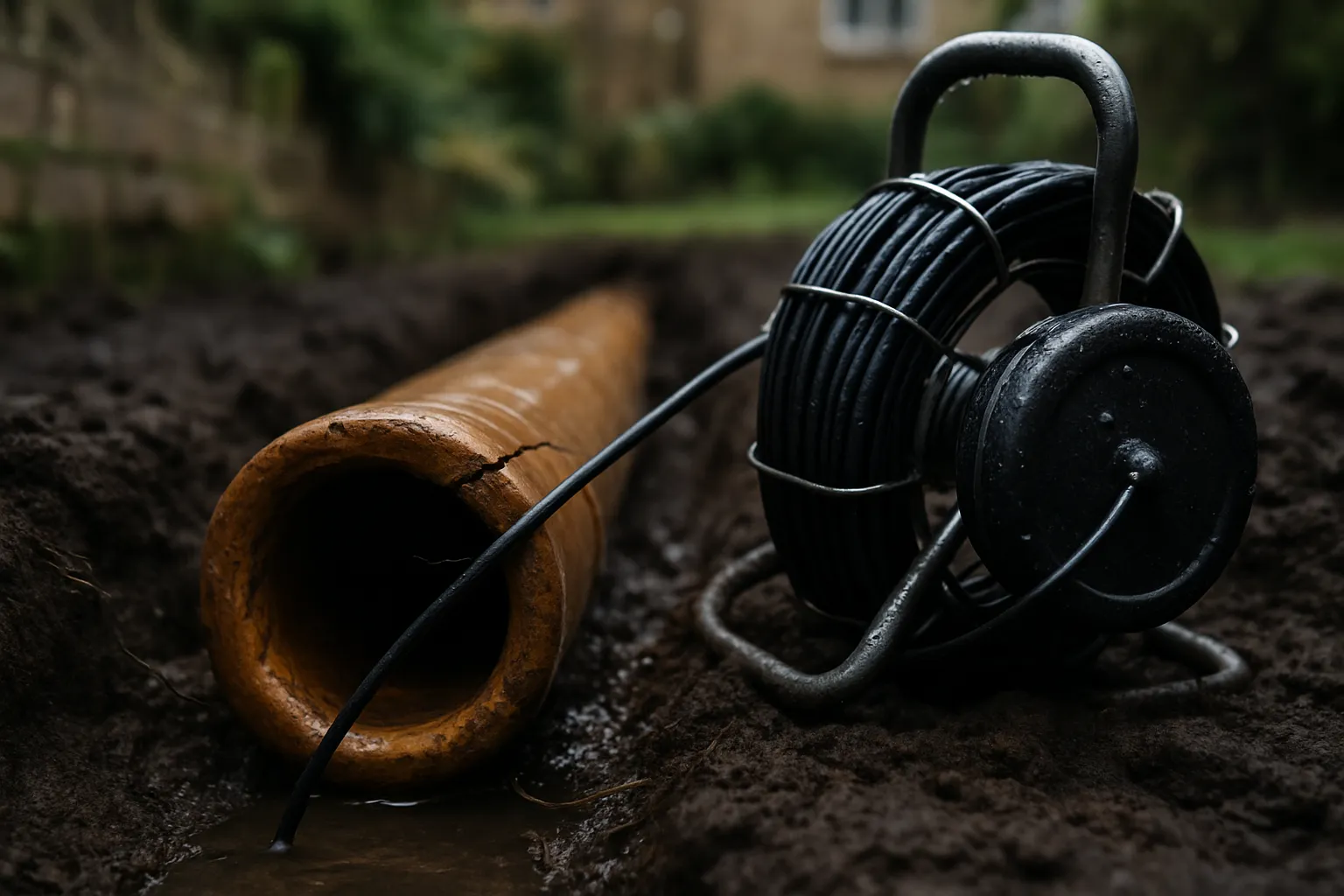
A CCTV drain survey (a camera pushed through the pipe on a flexible rod, transmitting live footage back to a screen) will locate the trap, show its condition and confirm whether it is blocked, cracked or simply sulking.
Rest Bends
A rest bend is a curved section of pipe, usually at the base of a soil stack (the vertical pipe that carries waste from upstairs), designed to change direction from vertical to horizontal without creating a sharp angle that would cause blockages. Hampton’s Edwardian terraces have them at the foot of almost every stack.
After 110 years, rest bends in original salt-glazed ceramic pipe develop hairline cracks. Those cracks let in groundwater during wet weather, which is why some Hampton homeowners notice their drains slow down specifically after rain. They also let tree roots in, which is a topic that deserves its own section.
Tree Roots and the Hampton Garden Problem
Hampton has beautiful gardens. Hampton also has mature trees, some of them planted around the same time as the drains were laid. Tree roots are drawn to the warm, nutrient-rich moisture that seeps from a cracked pipe. A root does not smash through ceramic in one dramatic moment. It finds a hairline crack, threads itself through, and then spends the next decade quietly filling the pipe like a very slow, very determined houseguest who was never invited.
By the time you notice a slow drain, a root mass the width of your forearm may already be established inside the pipe. CCTV survey footage of a mature root ingress (that is, roots that have grown into the pipe) looks, I will be honest with you, extraordinary. Like a rainforest in miniature. I have never not found it fascinating. The customer is usually less enthusiastic.
Root-blocked pipes can in most cases be cleared by high-pressure water jetting (a powerful, directed water jet that cuts through blockages and flushes debris away) and in more advanced cases may need pipe relining (a new structural sleeve inserted inside the old pipe without digging up your garden).
Shared Drain Runs
Many Hampton terraces were built with a single shared drain running beneath the back gardens of an entire row of houses before connecting to the sewer. This made sense in 1905. Today it means that a blockage in your neighbour’s section can back up into your property, and vice versa. It also means that responsibility for maintenance can be genuinely complicated, particularly where Thames Water’s records are incomplete or the drain has been partially adopted over the years.
A CCTV survey with a drain tracing report (a written record of the pipe’s route, depth and condition, with a surface map) is the only reliable way to establish exactly where your drain goes, whose land it crosses and where private responsibility ends and public sewer begins. This is particularly important if you are buying a period Hampton property and the conveyancer has flagged drainage as a query.
What a Survey Actually Costs
Indicative costs for a standard CCTV drain survey in Hampton currently run from around £90 to £250 depending on access, pipe length and whether a written report with footage is required. Jetting to clear a root blockage typically runs from £120 to £350. Pipe relining is more involved and is quoted individually after survey. These are honest ranges, not guarantees.
What to Do Next
If you have a period home in Hampton and your drains have been grumbling, slowing, backing up or doing anything that suggests they have developed a rich inner life, a CCTV survey is the sensible first step. It maps exactly what you have, shows the condition of every section, and tells you whether you need a jet, a reline or simply a cleared interceptor trap.
If you have an active blockage or flooding right now, do not wait. Call Drainiacs on 07700 137648, available 24 hours a day, seven days a week.