Emergencies
Blocked Drain Outside Your House in Twickenham: Whose Responsibility Is It?
Find out whether a blocked drain outside your Twickenham home is your problem or Thames Water's, and what to do right now.
Published 19 July 2026
Blocked Drain Outside Your House in Twickenham: Whose Responsibility Is It?
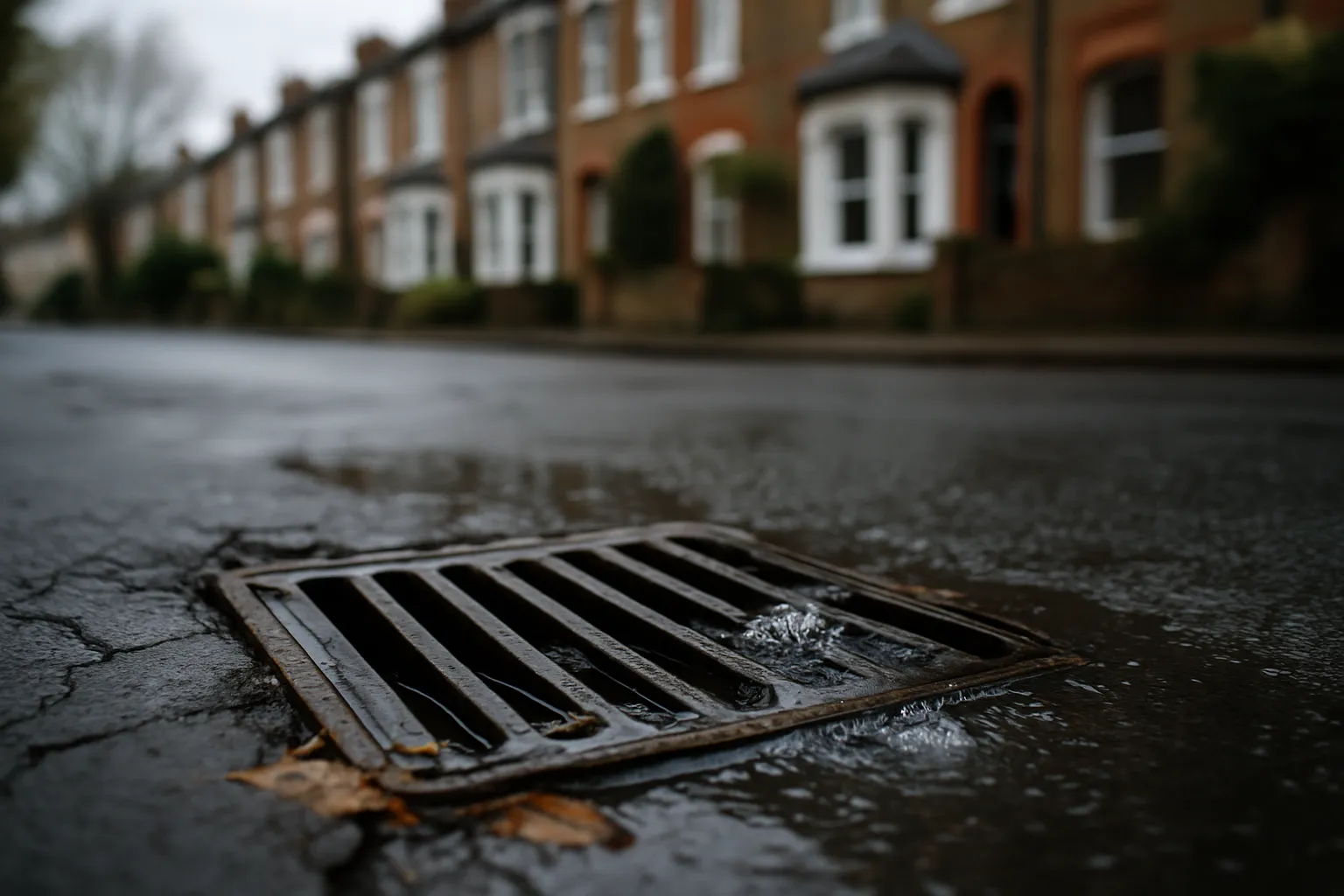
You have walked outside to find a drain cover bubbling like a tiny, enthusiastic volcano. Something is blocked. The question, before you reach for your wallet or your phone, is: whose problem is this legally? The answer depends on where the blockage sits and whether your drain is shared with your neighbours. Let us work through it.
The Basic Rule: Your Boundary, Your Drain
As a general principle, you are responsible for drains that sit entirely within your property boundary and serve only your home. That covers everything from the soil stack on the side of your house right up to the point where your drain connects to a shared pipe or to the public sewer.
Once water leaves your property boundary through a pipe that serves more than one home, it typically travels through what is called a lateral drain (a pipe running under or alongside the road, or under neighbouring land, that carries waste from several properties to the main sewer). Since 2011, lateral drains and public sewers in England have been the legal responsibility of the sewerage undertaker, which in Twickenham and across the TW postcode area is Thames Water.
So the short version:
- Blockage inside your boundary, serving only your home: your responsibility
- Blockage in a shared pipe beyond your boundary: Thames Water’s responsibility
Where It Gets Complicated: Shared Private Drains
Here is the part that catches people out. Some older properties in Twickenham, Richmond and across the TW area have drainage arrangements that were laid long before modern regulations. You may share a private drain with a neighbour that runs under your garden or their garden before reaching the public sewer. If that shared section is entirely within private land and has not been formally adopted by Thames Water, it can remain a private shared drain, and all the properties connected to it share the cost of repairs.
If you are unsure whether your drain has been adopted, Thames Water provides a public sewer map you can check online, or a drainage engineer can carry out a CCTV survey (a camera inspection of the pipe, like a tiny submarine expedition through your underground infrastructure) to establish exactly where the blockage is and who owns that section of pipe.
How to Work Out Where Your Blockage Is
Before calling anyone, a few quick checks help narrow things down:
- Is only your property affected? If your sinks, toilets and gullies are backing up but your neighbour is fine, the blockage is likely on your private run.
- Are multiple properties backing up? If neighbours are also affected, the blockage is probably in a shared or public section, which points toward Thames Water.
- Is the blocked gully outside your front or back garden? Surface water gullies on your land are usually your responsibility even if they are close to the boundary.
- Is the manhole cover in the road or pavement? Chambers in the highway are almost always Thames Water’s.
None of these checks is definitive on its own, but they give a useful starting point.
What Thames Water Will and Will Not Do
Thames Water will clear blockages in public sewers and adopted lateral drains at no charge to you. You can report these via their website or helpline. However, they will not attend to blockages on private drains, and if an engineer attends and determines the blockage is on your side of the boundary, you will need to arrange your own contractor.
This is where a local drainage company covering the TW area earns its keep. A professional engineer can locate the blockage with a CCTV survey, confirm which section of pipe is responsible, and either clear it on the spot with a high-pressure water jetter (a machine that fires a focused stream of water through the pipe to break up and flush away the blockage) or advise you formally if it turns out to be Thames Water’s problem to report.
Tree Roots, Fatbergs and the Usual Suspects
In the TW postcode area, the most common causes of external blockages on private runs are:
- Root ingress: tree roots finding a crack in an older clay pipe and growing inside it. Twickenham has no shortage of mature trees, and the roots are, professionally speaking, impressively determined.
- Grease and fat build-up: particularly in properties near the river where older pipe runs have shallow gradients.
- Collapsed or displaced pipe sections: common in Victorian-era drainage that has shifted over the decades.
A CCTV survey will identify all of these clearly, giving you the evidence you need whether you are negotiating with Thames Water, making an insurance claim, or simply deciding how urgently to act.
The Practical Next Step
If you have an active overflow, sewage backing up into a gully, or waste coming up inside the house, do not wait to work out the legal position. Get an engineer to the site first, establish the facts, and sort the responsibility question once the immediate problem is contained.
If you are in Twickenham or anywhere in the TW postcode area and need someone out now, call Drainiacs on 07700 137648. We are available around the clock, we will tell you honestly what we find and whose problem it is, and we will not charge you for work that is not yours to pay for.