Emergencies
Whitton's Wet Wipe Problem: Six Houses, One Pipe, Nobody's Fault
Six Whitton homes, one shared drain, and everyone flushing 'just a couple' of wipes. Nobody's the villain. The pipe just does the maths.
Published 18 July 2026
Six Houses, One Pipe, Nobody’s Fault
Welcome back to what the Drainiacs office has quietly started calling the Whitton Wipe Saga. If you found this page because your toilet is backing up right now, call 07700 137648 and we will be there. If you found it because you watched the Season 2 video and want the full written breakdown, settle in.
This is not a story about bad neighbours. This is a story about arithmetic.
The Setup: Whitton’s Interwar Terraces and Their Shared Rear Runs
Whitton’s interwar terraces, the kind that line the streets between the High Street and the park, were built with a shared drainage run at the back. One pipe collects from all the houses in the row and carries everything out to the main sewer. This was entirely standard practice in the 1930s and it works perfectly well, provided everyone puts the same things down it that the pipe was designed for.
The pipe was not designed for wet wipes.
The Word “Flushable” Has No Legal Meaning in the UK
This is the useful fact. There is no UK regulation that defines what a product must do before it can be labelled “flushable.” A manufacturer can print the word on a packet of wipes that will survive longer in your drains than most houseplants survive on a windowsill. Water UK, the industry body for water companies, has campaigned for a legally enforceable fine-to-flush standard for years. As of now, that word on a packet means nothing enforceable.
Toilet paper is designed to disintegrate. Drop a sheet in a glass of water, give it thirty seconds, and it falls apart. Do the same with a “flushable” wipe and you will be staring at a perfectly intact wipe an hour later. The fibres are bonded to survive contact with liquid. That is the entire point of a wipe. It is also the entire problem.
The Maths of a Shared Run
House one flushes two wipes. Fine, they travel down the pipe.
House two flushes two wipes. They catch on the first ones at the bend.
Houses three, four, five and six each flush two wipes. By now you have a soft, interlocking raft of twelve wipes sitting at a single point, and every flush from every household is compressing it further and adding to it. Nobody in that row is a monster. Nobody is flushing a whole packet at once. The pipe is simply doing the arithmetic that six households are not doing individually.
This is why the blockage always seems to appear from nowhere. There is no single culpable flush. There is just a slow accumulation that crosses a threshold on a Tuesday evening and suddenly number four has water rising in the pan.
What a Wipe Blockage Looks Like on a CCTV Survey
A CCTV drain survey means we send a small camera on a cable through the pipe and watch the footage on a screen. Think of it as a nature documentary, except the wildlife is worse and there is no David Attenborough.
A fat blockage, for comparison, looks like a cave narrowing. The walls of the pipe close in gradually, coated in a pale, waxy crust. It has a geological quality. Kev finds them beautiful. Kev is fine.
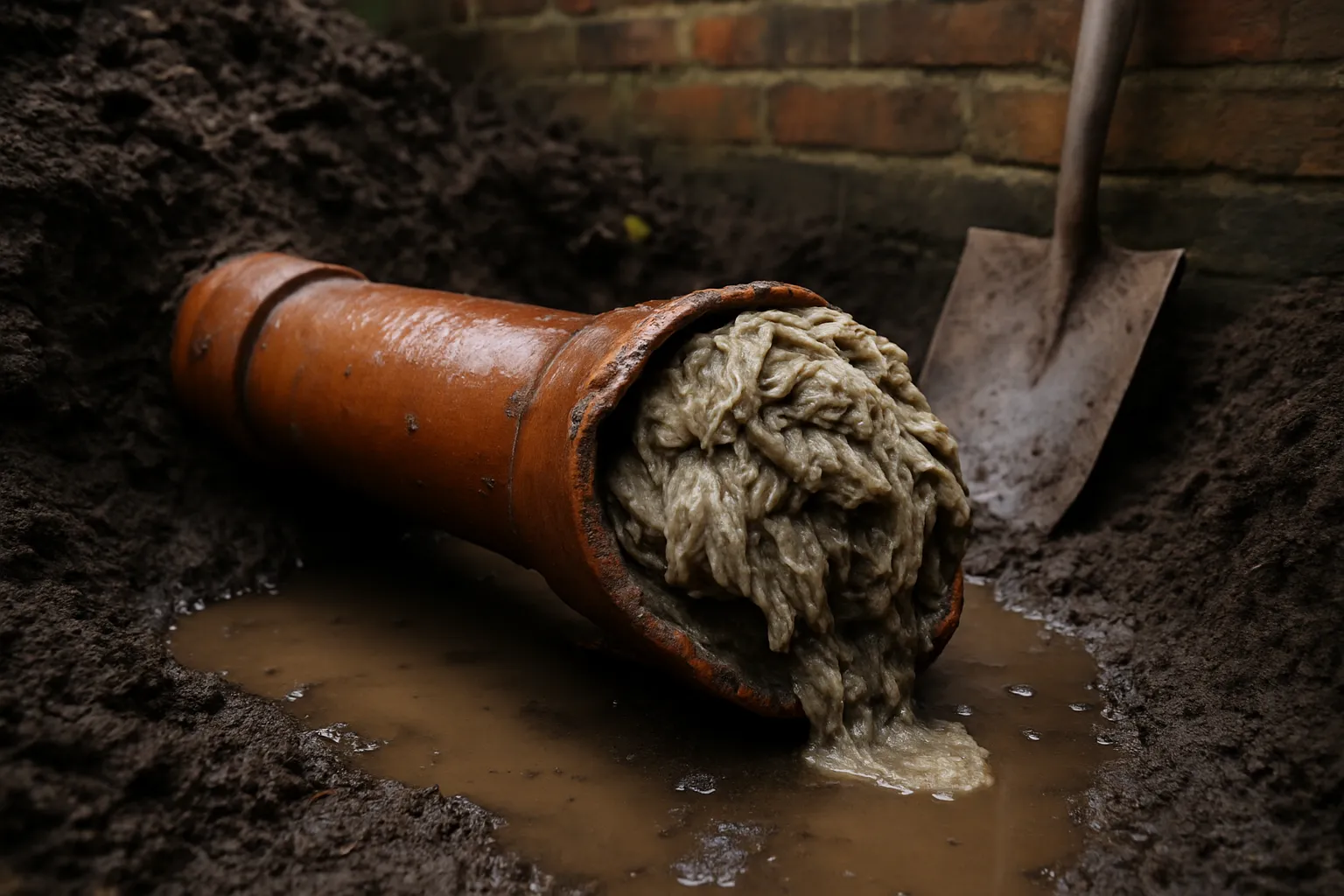
A wipe blockage looks completely different. The pipe is clear, clear, clear, and then there is a wall. A dense, fibrous, grey-beige wall that fills the pipe like a plug. Sometimes you can see individual wipes still layered in it. Sometimes grease has started to coat the outside and it is developing ambitions. Either way, the camera tells us exactly where it is, how dense it is, and whether there is anything structural behind it that needs attention, such as a cracked joint or a displaced pipe section that gave the wipe something to snag on in the first place.
CCTV surveys on a shared run typically cost in the range of £150 to £250 depending on the length and access points. That cost can be shared across the households on the run, which on a six-house terrace makes it very reasonable per door.
What Happens Next: Jetting
Drain jetting means we push a high-pressure water hose through the pipe. The nozzle faces backwards as well as forwards, so it simultaneously cuts through the blockage and flushes the debris back towards the access point. A wipe mass responds well to jetting. It breaks up, it flushes clear, and the pipe is restored to full bore. A typical jetting job on a residential shared run costs in the range of £100 to £200, again depending on access and severity.
We can usually give you an arrival time within the hour for an emergency call in the Whitton area. For a planned survey on a shared run, we will work with you to find a time that suits the households involved.
What to Actually Do
Stop flushing wipes. All six houses. The bin is right there. This is the only permanent solution and it costs nothing.
If the blockage is already happening, do not keep flushing to try to shift it. You will push the blockage tighter and risk an overflow. Turn off the water supply to the affected toilet if you can, and call us.
If you are on a shared run and you want to get ahead of this before it becomes an emergency, a CCTV survey will tell you whether there is already an accumulation building. It is much cheaper to jet a partial blockage than to deal with a full one.
If you are in Whitton and your drain is backing up right now, call 07700 137648. We cover the TW postcode area around the clock, every day of the year, and we will be with you.